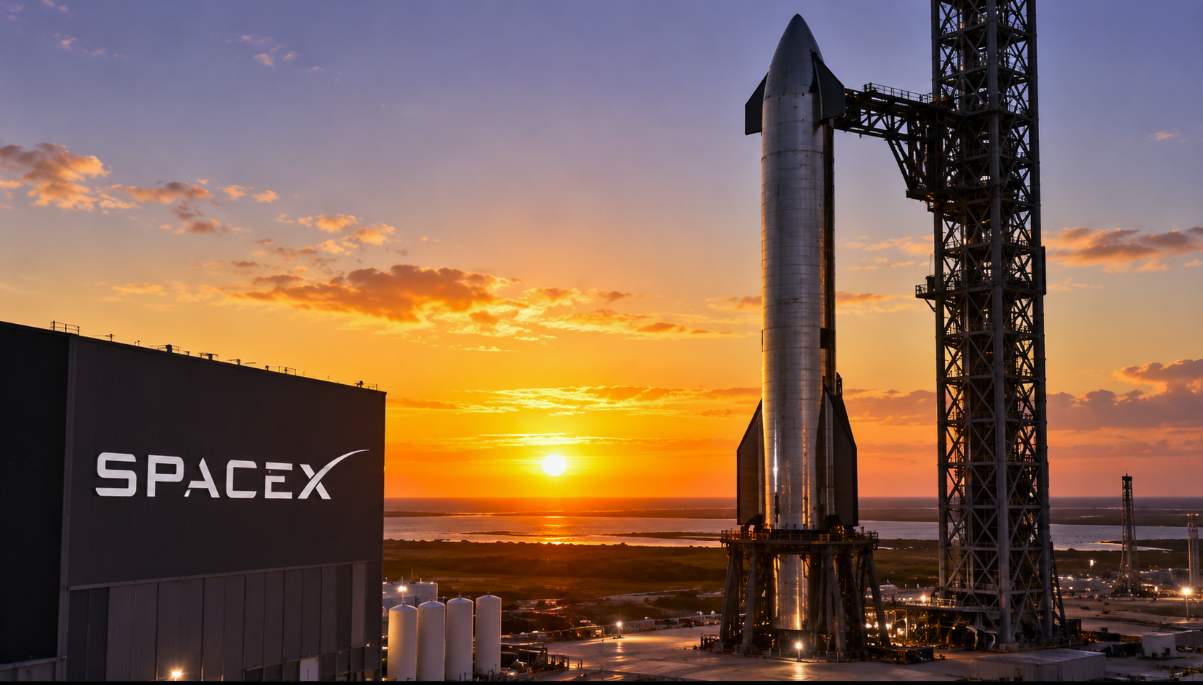
Starship's fourteenth flight test is becoming something SpaceX did not have to worry about when the company was private: a public-market event. The giant rocket could fly as early as mid-September, and investors are watching because Starship now sits underneath several of the businesses being used to justify SpaceX's enormous valuation — next-generation Starlink, orbital AI infrastructure and eventually much larger launch volumes.
Barron's framed Flight 14 as an increasingly important test for SpaceX shares on September 3. The company went public in June at $135 a share, raising roughly $85.7 billion in gross proceeds after the underwriters exercised their option in full. Since then, investors have had to value an unusual combination: a mature and rapidly growing communications business, the world's highest-cadence orbital launch operation and a collection of extraordinarily capital-intensive projects whose economics depend heavily on Starship becoming operational.
That makes Flight 14 different from earlier Starship tests. A spectacular failure would still primarily be an engineering event, and SpaceX has historically used failures as development data. But as a listed company, each major test also becomes evidence for or against assumptions embedded in the stock price. Starship is no longer only a rocket under development. It is becoming part of SpaceX's financial model.
The next milestone is orbit, not another spectacular flight
SpaceX has already demonstrated many of Starship's hardest individual maneuvers. Super Heavy boosters have returned toward the launch site, upper stages have survived increasingly demanding reentries, engines have relit in space and Starlink hardware has been deployed during test missions. Flight 13 in July successfully released 20 next-generation Starlink V3 satellites during a suborbital mission before the vehicle returned toward Earth.
Flight 14 is expected to go further. Regulatory paperwork cited by Barron's points toward an operation beginning around September 15 and describes an orbital second stage, suggesting that SpaceX intends to attempt sustained orbital insertion rather than repeat the suborbital profile used by earlier integrated tests. A regulatory filing establishes a potential operating window rather than a guaranteed launch date, so the schedule can still move.
SpaceX has also been preparing the hardware on the ground. In late August it completed a full-duration static fire involving all 33 Raptor engines on the Super Heavy booster assigned to the upcoming mission. That followed propulsion testing of the Starship upper stage and moved the vehicle deeper into its preflight campaign.
The distinction between suborbital deployment and operational orbit is economically important. Once Starship can place functioning satellites into intended orbits, the rocket can begin doing productive work while SpaceX continues testing recovery and reuse. Full reusability does not need to arrive on the same flight as useful payload delivery.
Starlink V3 turns Starship into a revenue infrastructure project
The most immediate commercial reason SpaceX needs Starship is Starlink V3. In its Starship V3 technical update, SpaceX says the new rocket will begin delivering the much more powerful V3 satellites to orbit this year. The company claims each Starship V3 deployment will eventually add more than 20 times the network capacity of a current Falcon launch carrying V2 Starlink spacecraft.
That changes the relationship between rocket development and the communications business. Falcon 9 has been extraordinarily effective at building the current Starlink constellation, but the larger V3 architecture is designed around Starship's payload capability. If SpaceX wants to expand network capacity at the scale described to investors, Starship needs to become a dependable transportation system rather than an occasional experimental vehicle.
The logic creates a powerful internal feedback loop. Starlink supplies a large captive payload for Starship. Starship can deploy much more Starlink capacity per flight. Additional network capacity can support more customers and services, producing cash that can help finance further launch infrastructure.
SpaceX's second-quarter results show why investors care about that loop. Reuters reported that Q2 revenue reached about $7.8 billion, up from roughly $4.1 billion a year earlier, with Starlink accounting for more than half of the total. Capital expenditure also surged as the company invested aggressively in AI and infrastructure. Those numbers make the transition from Falcon-scale deployment to Starship-scale deployment a business issue rather than an abstract engineering ambition.
Starmind makes the mass-to-orbit problem even larger
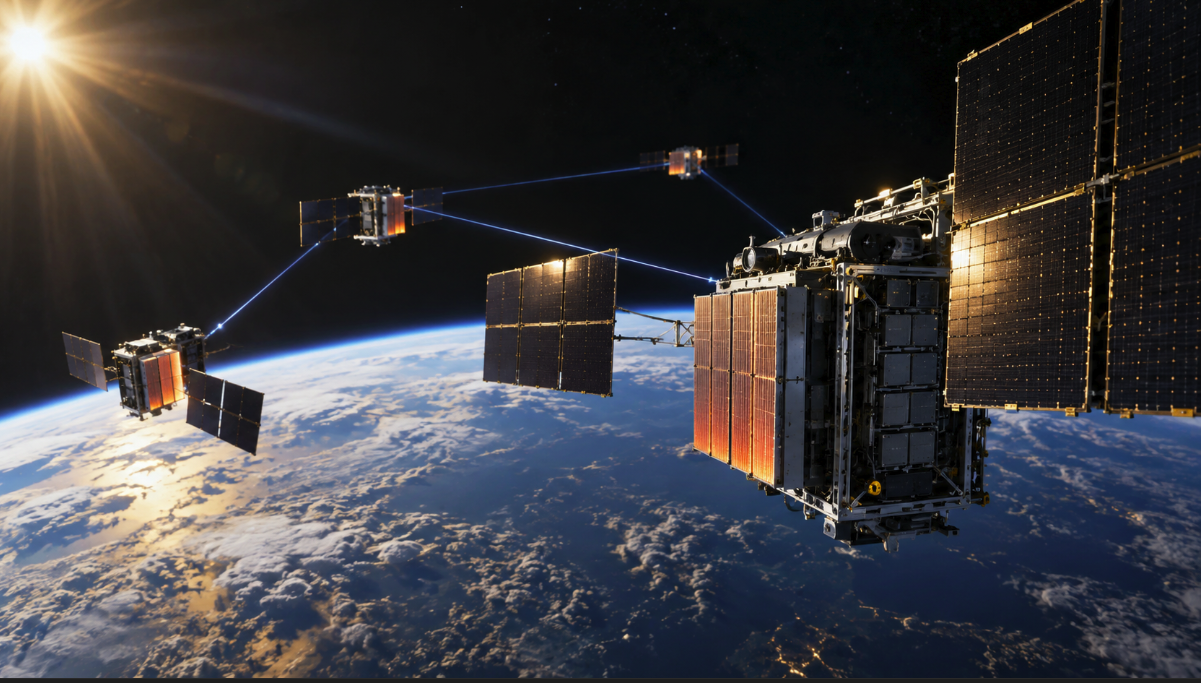
Starlink is no longer the only internal project that depends on cheap heavy launch. SpaceX is also developing Starmind, its proposed orbital AI-compute system. SpaceX describes the AI1 satellite as a large platform carrying up to 250 kilowatts of peak compute payload and using solar energy, radiative cooling and laser links to send results through the Starlink network.
The company explicitly identifies mass to orbit as one of the fundamental constraints on orbital AI. Its Starmind strategy assumes that Starship's payload capacity and reuse can make launching large numbers of heavy compute satellites economically feasible. SpaceX says it is building a Gigasat Factory in Bastrop intended to support production of thousands of AI satellites beginning as soon as late 2027.
Those plans magnify the financial importance of Starship. A delayed reusable rocket does not merely postpone Mars. It can delay the infrastructure needed for a new business SpaceX is already presenting as a major growth opportunity.
The scale of the vision is extreme. SpaceX has discussed Starship launches carrying roughly 200 tons at frequencies eventually measured in launches per hour. Such cadence is far beyond anything demonstrated by the global launch industry. Investors should therefore separate the direction of travel from the mature-state economics: Flight 14 can validate orbital capability, but it cannot validate thousands of annual launches or the cost assumptions required for gigawatt-scale orbital computing.
Public markets have changed the meaning of a Starship failure
SpaceX's development culture has long treated hardware loss as an acceptable cost of learning. That approach helped the company iterate Falcon landing technology and has been central to Starship. A prototype can fail dramatically while the program still makes progress if the test produces useful data.
Stock markets operate on a different clock. Investors react not only to whether engineers learned something but to what a result implies about schedules, capital requirements and future cash flows. Repeated Starship setbacks can therefore be technically productive while still reducing the present value investors assign to businesses that require the rocket.
The company's June IPO made that tension visible. SpaceX priced the offering at $135 per share, and the stock has since traded around a valuation measured well above $1 trillion. That leaves less room for Starship to remain indefinitely experimental because significant future growth is already being priced into the company.
At the same time, a single successful Flight 14 should not be mistaken for proof that Starship's economics work. Reaching orbit and deploying payloads would validate a crucial capability, but the financial thesis depends on repeatability. SpaceX must increase cadence, recover hardware, reduce refurbishment, scale Raptor production, expand launch sites and ultimately reuse the upper stage.
Falcon 9 gives SpaceX time — but also sets the benchmark
SpaceX has one enormous advantage while developing Starship: it already owns a highly successful launch business. Falcon 9 continues to fly Starlink, commercial, crewed and national-security missions at a cadence unmatched by competitors. That means a Starship delay does not eliminate SpaceX's ability to generate launch revenue or expand the current Starlink network.
But Falcon 9 also makes Starship's economic hurdle more demanding. Starship must eventually outperform a system whose boosters routinely fly again and whose operations have been refined over hundreds of missions. Simply reaching orbit is not enough to justify replacing Falcon-scale economics.
SpaceX's strategy is therefore to give Starship jobs Falcon cannot efficiently perform. V3 Starlink satellites are larger and more capable. Starmind satellites would be dramatically heavier. Lunar Starship missions require capabilities outside Falcon's architecture. Mars ambitions require another scale entirely.
This is why Flight 14 can matter to investors without becoming a binary verdict on the company. Falcon and existing Starlink operations provide a substantial business underneath the experiment. Starship determines how much larger that business can plausibly become.
The stock is increasingly a bet on launch cost
SpaceX is unusual because several of its biggest future markets converge on the same physical variable: the cost and frequency of moving mass into orbit. More Starlink capacity requires satellites. Orbital AI requires enormous compute platforms. Lunar infrastructure requires cargo and propellant. Mars requires mass at a scale that makes today's launch industry look small.
Starship is the mechanism intended to reduce that constraint. If it becomes rapidly reusable, SpaceX can use cheap launch not merely as a product sold to customers but as an internal advantage that enables businesses competitors cannot economically replicate. In that sense, Starship is closer to infrastructure than a conventional rocket product.
That also means its development risk propagates through the company. A two-year delay in a normal launch vehicle affects launch revenue. A two-year delay in Starship can affect the pace of Starlink V3 deployment, orbital AI plans, lunar contracts and the capital required to maintain parallel systems while development continues.
Flight 14 will not resolve those questions. What it can do is move the argument one level forward. If Starship reaches a stable orbit and deploys useful payloads, investors can begin asking how quickly SpaceX can repeat the mission and recover the upper stage. If it fails before reaching those objectives, the market will have to reassess how much more time and money separate the current test program from the launch economics embedded in SpaceX's most ambitious forecasts.
Before the IPO, Starship tests mostly answered a question for engineers: what did the vehicle teach SpaceX this time? As Flight 14 approaches, there is now a second audience asking a different question. Public shareholders want to know when the world's largest experimental rocket starts behaving like the infrastructure their valuation assumes it will become.