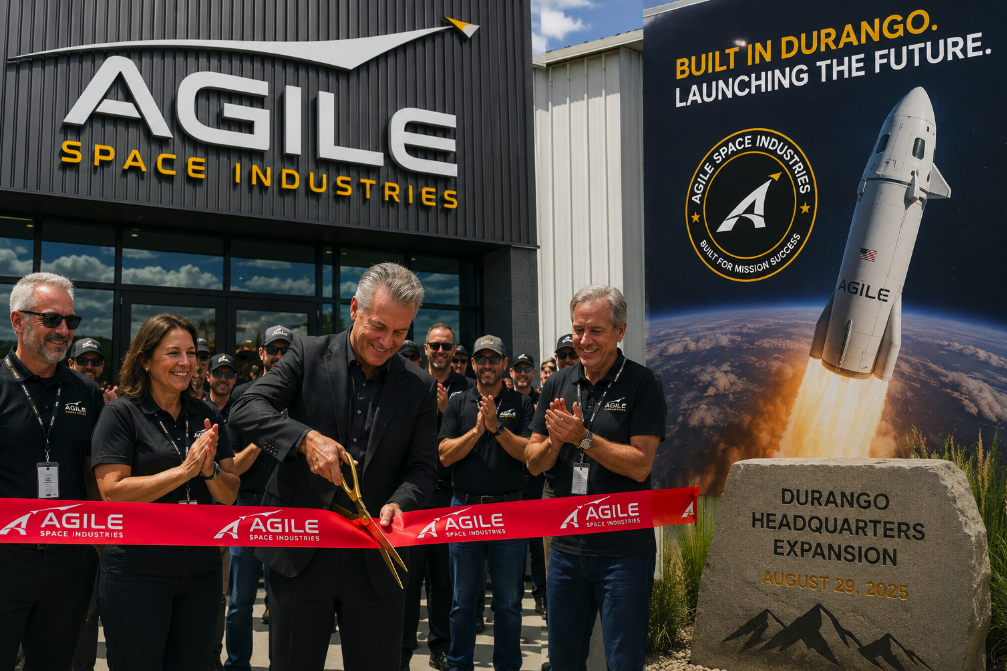
A ribbon cutting in southwest Colorado would normally be a local business story. Agile Space Industries’ new headquarters expansion in Durango is more revealing than that. The propulsion company is adding manufacturing and office capacity as it moves from a small specialist into a supplier serving lunar, commercial and national-security missions — exactly the kind of industrial layer the expanding space economy increasingly depends on.
SpaceNews reported on the headquarters expansion as Agile marked the opening with employees and public officials. The company’s own announcement says the additional building expands its Durango capabilities and supports a growing workforce. Local reporting adds an important measure of the change: Agile has grown from roughly a dozen employees around the start of its current corporate phase to about 170, and CEO Chris Pearson says it plans to reach approximately 400 employees within three to four years.
The interesting part is not the new office space. It is what Agile is building around it. Durango is becoming the engineering and rapid-development center in a distributed propulsion network that includes additive manufacturing, production and increasingly sophisticated rocket-engine testing. In an industry focused on giant launch vehicles and satellite constellations, companies such as Agile occupy a less visible but increasingly strategic position: they make the hardware that allows spacecraft to maneuver after launch.
The bottleneck moves after the rocket reaches orbit
Launch has become dramatically more available over the past decade, but reaching orbit does not eliminate the propulsion problem. Satellites still need to change or maintain orbits, rendezvous with other spacecraft, transfer toward the Moon or deeper space, control their attitude and sometimes perform rapid maneuvers for national-security missions.
Agile specializes in chemical in-space propulsion, including hypergolic thrusters and engines. These systems use propellants that ignite on contact, an architecture valued for reliable starts and the ability to perform repeated burns. The company combines propulsion design with metal additive manufacturing and hot-fire testing, allowing it to iterate hardware more rapidly than a traditional model in which design, manufacturing and testing are spread among separate suppliers.
That integrated approach is becoming more valuable as spacecraft missions diversify. Agile has supplied or developed propulsion for lunar landers, commercial spacecraft, orbital vehicles and defense applications. In 2025, for example, it announced a contract to provide DS250 bipropellant thrusters for The Exploration Company’s Nyx spacecraft, which is targeting a mission to the International Space Station in 2028.
Agile’s Durango test stands have also supported Firefly Aerospace’s Spectre engines, hardware associated with the Blue Ghost lunar program. That is a useful illustration of the company’s position: Agile does not have to build the spacecraft or own the mission to become embedded in the mission’s critical path.
Durango is becoming the prototype engine of a distributed factory
The new facility is designed around closer interaction between engineering and manufacturing. The Durango Herald’s report on the ribbon cutting describes linked office and manufacturing areas where engineers can move between design work and physical hardware. Agile executives told the newspaper that Durango develops difficult prototypes, while other facilities can take repeatable designs toward larger-scale production.
The company is also changing where some of its manufacturing occurs. Metal additive manufacturing has historically been performed at Agile’s Pennsylvania operation, but the expansion includes bringing additional manufacturing into the Durango area. Additive manufacturing is particularly useful for rocket propulsion because it can consolidate complicated fluid passages and combustion hardware into fewer components while enabling geometries that are difficult to machine conventionally.
Agile’s growth is not confined to Colorado. In January, the company broke ground on the first $20 million phase of a new Space Test Center in Tulsa, Oklahoma. Agile describes the project as the opening phase of a potentially $200 million propulsion-testing ecosystem designed to provide high-throughput hot-fire testing for commercial, civil and national-security customers.
The geographic split is significant. Durango can remain a center for engineering, prototyping and specialized production while Tulsa develops capacity for testing and scale. That resembles the industrial structure emerging elsewhere in commercial space: specialized centers connected into a network rather than every capability being concentrated at a single enormous aerospace campus.
National security is pulling propulsion into the spotlight
The Durango ceremony also highlighted a second source of demand. U.S. Sen. John Hickenlooper attended the event and emphasized the resilience created by geographically distributed aerospace manufacturing. According to the Durango Herald, Agile CEO Chris Pearson said the company has received a $30 million U.S. Department of Defense award connected to developing and supplying components for U.S. Space Force needs.
That demand reflects a broader change in military space architecture. Satellites are increasingly expected to be maneuverable, rapidly deployable and resilient rather than simply inserted into a fixed orbit for a long operational life. Space-domain-awareness missions, responsive operations and the ability to reposition assets all increase the value of propulsion systems that combine reliability with high performance.
Agile has previously announced work with defense-focused companies including True Anomaly and has described its customer mix as spanning national security, exploration, commercial and international markets. This diversification matters because it reduces dependence on any single lunar program or satellite segment while giving the company multiple reasons to invest in capacity.
The propulsion supply chain is also a strategic vulnerability. A satellite can be delayed even when its payload, software and launch are ready if a qualified propulsion component is unavailable. Long lead times for aerospace hardware can therefore constrain programs far larger than the supplier itself. Expanding domestic design, manufacturing and testing capacity is increasingly treated as industrial resilience rather than ordinary subcontracting.
The financial story is moving from startup funding to capacity
Agile’s expansion follows a period of rapid commercial growth. In its Series A announcement, the company said revenues had more than tripled over the preceding three years while bookings increased more than sixfold. The financing round ultimately reached $17 million, above an initial $15 million target, with participation from investors including Lockheed Martin Ventures.
Agile said at the time that it had already booked enough business to nearly double its 2025 revenue. Those are company-reported figures rather than independently audited public-company results, but they explain why physical capacity has become a central issue. Once an aerospace startup moves from prototype contracts to recurring engine orders, the challenge changes from proving that the hardware works to producing qualified hardware repeatedly and on schedule.
That transition can be difficult. Rocket engines and thrusters cannot be scaled like ordinary electronics. Manufacturing changes require qualification, testing consumes specialized infrastructure, and defects can destroy expensive spacecraft. Customers also expect traceability and extremely tight tolerances. Growing faster therefore requires investment not only in floor space but in test stands, clean rooms, tooling, inspection, skilled technicians and quality systems.
Agile’s expansion is a bet that demand will justify that fixed infrastructure. If bookings translate into recurring production, the facilities become a competitive advantage. If commercial space demand slows or major programs slip, the same infrastructure can become expensive unused capacity. The company’s mix of civil, defense and commercial customers is one way of reducing that risk.
The Moon is only one destination
Agile initially became visible through lunar propulsion. Its A110 thruster was qualified for lunar-lander applications, while the larger A2200 was designed as a deeply throttleable engine for landing missions. The company has also developed smaller thrusters such as the M4 for attitude and positioning control, rendezvous, docking and servicing missions.
That product spread points toward a larger market than lunar landers. The next phase of space infrastructure includes orbital transfer vehicles, refueling, inspection, servicing, logistics and spacecraft that need to maneuver more frequently than conventional satellites. Each of those architectures creates propulsion demand after the launch vehicle has completed its job.
This is why Agile’s Durango expansion is more meaningful than the ribbon itself. The commercial space economy is entering a phase where its less glamorous industrial components — engines, valves, tanks, test facilities and manufacturing capacity — can determine how quickly ambitious missions actually fly.
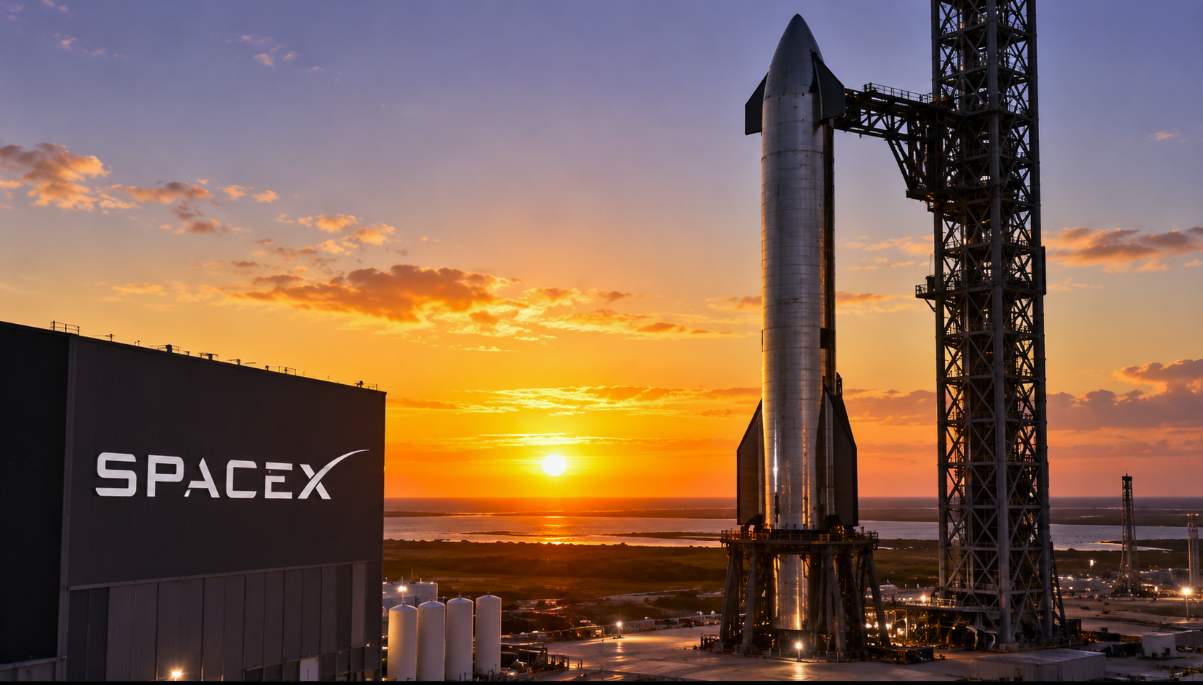
SpaceX made launch cadence a central measure of the modern space industry. The next constraint may increasingly be what spacecraft can do after separation from the rocket. Agile is building around that assumption: more spacecraft, more maneuvering, more lunar and national-security missions, and therefore more demand for propulsion that can be manufactured and tested without becoming the bottleneck. Durango’s new building is a small physical footprint compared with a launch complex, but it represents the kind of infrastructure the next stage of the space economy will need in much larger quantities.