The idea of putting data centers in space is no longer confined to speculative presentations. Google is preparing an orbital experiment for its Project Suncatcher research program, SpaceX has publicly described massive AI-compute satellite constellations as part of its future infrastructure, and startup Starcloud says it has already operated an Nvidia H100 GPU in orbit. The question has therefore changed: it is no longer whether computers can run AI workloads in space, but whether orbital computing can ever compete with the economics, reliability and scale of terrestrial data centers.
That distinction matters as AI infrastructure collides with constraints on Earth. Large data centers require enormous amounts of electricity, grid connections, land and cooling infrastructure. The U.S. Government Accountability Office said in April 2026 that space-based facilities could reduce some terrestrial demand for electricity, water and physical infrastructure, but stressed that large orbital data centers remain unproven and face substantial engineering and economic barriers.
Why space looks attractive for AI
The strongest argument for orbital computing is energy. In Project Suncatcher, announced in November 2025, Google proposed compact constellations of satellites carrying its Tensor Processing Units and communicating through free-space optical links. The company says that in an appropriate orbit a solar panel can be up to eight times more productive than one on Earth, while near-continuous sunlight can reduce dependence on batteries.
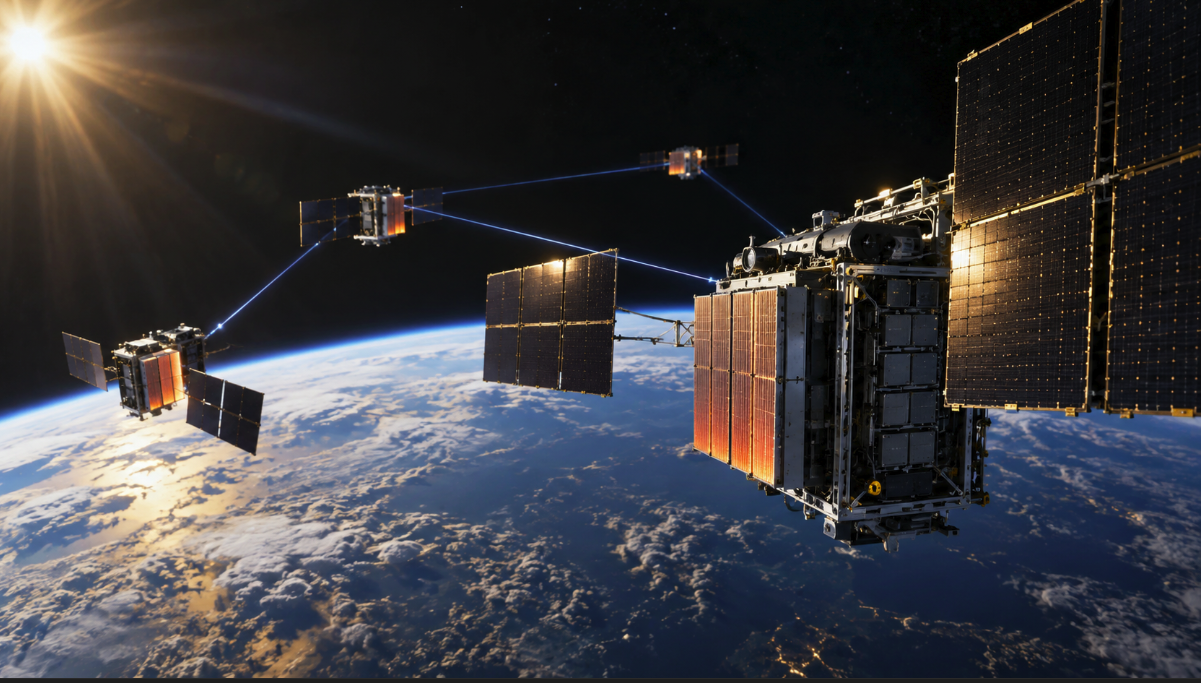
Google's concept uses a dawn-dusk sun-synchronous low-Earth orbit and tightly clustered spacecraft rather than one enormous orbital structure. Its technical preprint identifies several problems that must be solved together: high-bandwidth inter-satellite communication, formation control, radiation-tolerant computing, thermal management, ground communications and sufficiently low launch costs. Google has said it plans a learning mission with Planet to launch two prototype satellites around early 2027 and test hardware in orbit.
The idea is also gaining commercial momentum beyond Google. Starcloud says its Starcloud-1 satellite, launched in November 2025, carried the first Nvidia H100 GPU into orbit. The company also says the spacecraft subsequently ran a version of Google's Gemma model and trained a small language model in space. Those demonstrations are far removed from a hyperscale data center, but they establish an important baseline: modern AI accelerators can perform useful computation after launch.
The hardest problem may be getting rid of heat
Space offers abundant sunlight, but it does not provide effortless cooling. A terrestrial data center can move heat into air or water. In a near-vacuum, there is almost no surrounding matter to carry heat away through convection, so a spacecraft must ultimately reject waste heat by radiation. The GAO describes cooling at data-center scale as unproven and warns that large facilities would require thermal systems capable of dissipating substantial waste heat without becoming prohibitively large or heavy.
This creates a fundamental design tension. More computing power means more electrical power and, ultimately, more heat to reject. Larger radiators and solar arrays add mass and surface area, which can increase manufacturing and launch costs while complicating spacecraft control. The glamorous part of the orbital-data-center story is effectively unlimited solar energy; the less glamorous engineering reality is that every watt consumed by processors eventually has to be managed as heat.
Radiation presents another constraint. High-energy particles can corrupt data and degrade electronics, forcing designers to use shielding, redundancy, error correction or more radiation-tolerant components. Google's research includes radiation testing of its TPUs, but laboratory results are not the same as years of operation in orbit. Hardware failures are also much harder to address when technicians cannot simply walk into a server hall and replace a failed accelerator, power supply or optical module.
An orbital data center is also a network problem
AI clusters depend on extremely fast connections between accelerators. Google's architecture therefore requires satellites to behave less like independent spacecraft and more like racks inside a distributed data center. Its research envisions high-capacity optical links and close formation flying, with spacecraft potentially separated by distances on the order of a kilometer or less. Maintaining that geometry across a large constellation adds a layer of orbital dynamics that conventional terrestrial infrastructure never has to solve.
Connectivity to Earth introduces another trade-off. Processing data generated in orbit can make immediate sense because a satellite can analyze imagery or sensor readings before transmitting only useful results to the ground. The GAO identifies this as one of the more promising near-term applications. Training enormous AI models on datasets that originate on Earth is a different proposition: the data must first reach the orbital cluster, and useful outputs must return through communications infrastructure whose bandwidth, latency and cost become part of the overall system.
Launch economics decide whether the vision scales
SpaceX's own ambitions illustrate why launch cost is central. In company prospectus material published in 2026, SpaceX argued that reusable rockets, satellite manufacturing and Starlink connectivity could support massive AI-compute constellations in sun-synchronous orbit. Google, meanwhile, confirmed in May that it had been discussing future Project Suncatcher launches with SpaceX and other providers, according to Reuters. Cheap, frequent and high-capacity launch is not merely an enabling technology for orbital data centers; it is one of the assumptions on which their business case depends.
Today's economics do not yet prove that orbit wins. Space hardware must survive launch and radiation, operate with limited servicing, carry its own power and thermal systems, and be placed in orbit before producing useful computation. Terrestrial data centers have their own expensive constraints, but they benefit from mature construction, networking and maintenance ecosystems. Orbital computing becomes more compelling only if launch and spacecraft costs fall sufficiently while terrestrial power and infrastructure constraints continue to tighten.
The first winners may not look like data centers on Earth
The most plausible early market may therefore be specialized rather than a wholesale migration of cloud computing into orbit. Satellites that process Earth-observation data locally, scientific spacecraft that filter huge sensor streams, or AI systems serving other assets in space can avoid repeatedly sending raw data down to Earth. These workloads exploit the unique location of the compute rather than merely relocating an existing terrestrial server farm.
Large-scale AI training or inference in orbit remains a more ambitious target. The next decisive evidence will come from real missions: whether high-performance accelerators remain reliable under radiation, whether optical links can sustain data-center-like networking, whether thermal systems scale, and whether launch costs fall quickly enough to make replacement and expansion economically tolerable. Google's planned prototypes and the growing number of commercial experiments will turn those assumptions into measurements.
Orbital data centers are thus neither an obvious fantasy nor an imminent replacement for facilities on Earth. Useful AI computation has already reached orbit, while serious engineering teams are testing the components needed to scale it. What remains unresolved is the part that determines whether a technological demonstration becomes infrastructure: whether power, cooling, communications, reliability and launch can all work at the same time, at a price customers are willing to pay.