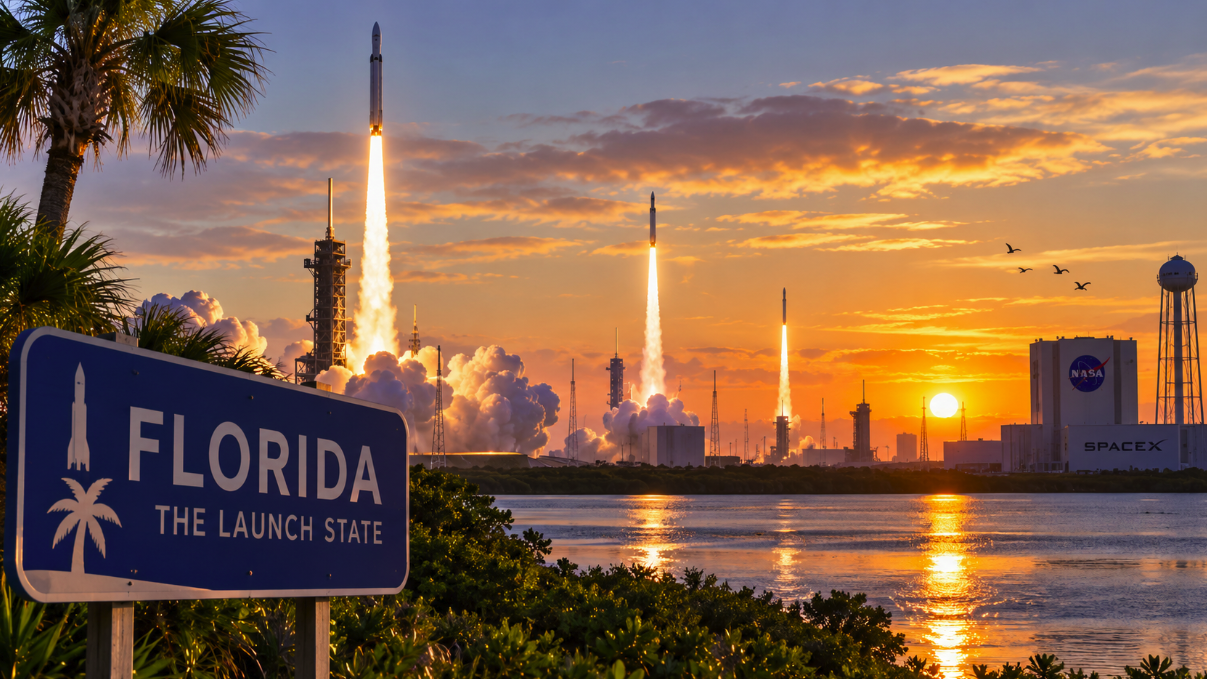
Florida's Space Coast is no longer operating like a launch site that occasionally hosts major missions. It is becoming something closer to transportation infrastructure. Cape Canaveral and Kennedy Space Center now support launches often enough that the difficult question is shifting from whether rockets can fly frequently to whether roads, pads, airspace, propellant systems, utilities and range operations can scale with them.
Florida Today highlighted the accelerating launch rate on September 3, as Florida's aerospace industry continues moving beyond the cadence that defined the Space Shuttle era. Official U.S. Space Force data make the structural change clear: the Eastern Range supported 109 orbital launches in 2025, the first year Cape Canaveral crossed the triple-digit threshold. By August 31, Space Launch Delta 45 listed 55 space launch operations for 2026.
Those numbers matter, but the more revealing forecast is what the Space Force believes could come next. Its Orbital Futures 2040 planning document models annual launch demand at Cape Canaveral Space Force Station rising from roughly 110 launches in 2025 toward approximately 1,200 by 2036 under an optimistic demand scenario. The same analysis makes clear that the range itself cannot simply absorb that theoretical demand without major changes: simulated operational capacity remains far below the raw forecast.
The emerging bottleneck is therefore not rockets. It is the spaceport.
Florida has already crossed from exceptional launches to routine launches
The transformation can be seen in how the Eastern Range describes its own operations. In the second quarter of 2026 alone, Space Launch Delta 45 supported 21 launches. In April, it set a 60-year record by supporting orbital missions from five different launch-vehicle types in a single month.
The Space Force said the April milestone surpassed a record established more than six decades earlier. The importance was not merely the number of missions but their diversity. A spaceport that can rapidly switch among launch providers and vehicle architectures is fundamentally different from one optimized around a handful of government programs.
SpaceX remains the dominant driver of cadence. Falcon 9 launches Starlink satellites, commercial spacecraft, crew missions and government payloads at a frequency no previous U.S. orbital vehicle approached. But Florida's future demand is broader. United Launch Alliance's Vulcan is entering regular operations, Blue Origin is scaling New Glenn, and heavy-lift, lunar and national-security missions increasingly share the same geographic launch ecosystem.
The result is a scheduling problem that extends beyond launch pads. Every mission requires range safety, weather support, airspace and maritime coordination, payload processing and ground infrastructure. More vehicles also mean different fuels, procedures, hazard areas and recovery operations.
The Space Force's own forecast exposes the capacity gap
The most striking numbers appear in the U.S. Space Force's Orbital Futures 2040 baseline. Its optimistic demand scenario projects Eastern Range activity rising from 110 launches in 2025 to 127 in 2026, 269 in 2028, more than 600 by 2030 and 1,235 by 2036.
Those figures should not be interpreted as a prediction that more than 1,200 rockets will definitely leave Cape Canaveral in 2036. They are demand projections used for infrastructure planning. The same document models a much lower operational maximum, around 380 annual launches by the mid-2030s, with a 50th-percentile simulation closer to the low 200s.
That difference is the important story. Under aggressive commercial and national-security growth assumptions, potential demand could exceed modeled range throughput by hundreds of launches per year. Even if actual demand falls far below the optimistic case, Florida may still need to support two or three times today's launch activity.
This turns launch infrastructure into an economic constraint. A rocket company can build more boosters, but it cannot independently expand restricted airspace, redesign shared transportation networks or eliminate conflicts among multiple pads. Those are system-level problems involving federal agencies, state government, launch companies and surrounding communities.
Reusable rockets changed what a launch site has to optimize for
Traditional launch infrastructure was built around relatively low flight rates. Vehicles could occupy pads for long periods because launches were rare and expensive. Reusable rockets reverse that assumption.
Falcon 9 boosters routinely return from missions and fly again, shifting part of the operational challenge from manufacturing new rockets toward processing, inspection and rapid pad turnaround. As reuse expands to larger vehicles, spaceports must support a transportation loop rather than a one-way departure.
That creates new infrastructure requirements. Landing zones and drone-ship operations must coexist with launch traffic. Recovered stages need transportation and refurbishment. Propellant must be delivered at greater volume. High-cadence operations need resilient power, communications and road access. Range systems must clear missions faster without reducing safety margins.
The Space Force demonstrated the importance of operational resilience in May, when an anomaly at one launch complex did not prevent the Eastern Range from supporting a Falcon 9 mission less than 12 hours later. Space Launch Delta 45 described the event as evidence that the range could remain mission capable while responding to a separate incident. That kind of isolation becomes increasingly important as launch frequency rises: one pad problem cannot be allowed to shut down an entire spaceport.
Florida is spending to keep the ground from becoming the bottleneck
The state is already treating spaceport infrastructure as an economic-development asset. Space Florida says its Spaceport Improvement Program has invested more than $500 million across dozens of projects while helping leverage billions of dollars in industry investment.
In February, Space Florida said more than $531 million in state investment had been paired with approximately $3.3 billion in private industry funding. The program supports common-use infrastructure and company-specific expansion at facilities including Kennedy Space Center and Cape Canaveral Space Force Station.
The investments are increasingly mundane by spaceflight standards, which is exactly why they matter. Utilities, roads, runways, processing areas and manufacturing facilities do not generate the imagery of a rocket launch, but high flight rates depend on them.
Cape Canaveral's historic Skid Strip, for example, reopened in April after a two-year renovation of the 10,000-foot runway. The Space Force said the project modernized infrastructure used to move heavy military aircraft and payloads in support of record launch cadence. Space Florida has separately invested in the Kennedy Launch and Landing Facility, including a mile-long utility corridor intended to unlock hundreds of acres for commercial development.
These projects reveal the next phase of the space economy. The competitive advantage of a launch region increasingly depends not only on latitude and available pads but on whether industrial facilities can be built, payloads transported, workers housed and utilities expanded fast enough to match rocket demand.
More launches also mean more conflicts outside the fence
A launch temporarily affects far more territory than the pad itself. Hazard areas can close airspace and portions of the Atlantic to aircraft and ships. Roads around Kennedy and Cape Canaveral can be affected by operations. Nearby communities experience sonic booms, traffic and environmental effects.
At low cadence, those disruptions are exceptional events. At hundreds of launches per year, they become recurring transportation and land-use questions. The challenge is particularly acute when multiple launch providers want overlapping windows or when weather compresses several missions into the same period.
Automation can increase capacity. Modern autonomous flight-safety systems reduce dependence on traditional range infrastructure and can shorten turnaround between missions. Better scheduling, tracking and hazard modeling can also make airspace and maritime closures more precise. But technology cannot remove every conflict when many rockets share a narrow coastal corridor.
This is one reason future launch growth may distribute across several U.S. spaceports rather than remaining concentrated in Florida. Vandenberg Space Force Base is undergoing its own rapid cadence increase, while commercial facilities in Texas, Virginia and elsewhere are expanding. Florida's scale is an advantage, but concentration also creates systemic pressure.
The real space race may be measured in throughput
For most of the space age, launch success was measured mission by mission. A rocket lifted off, delivered its payload and the range prepared for the next campaign. The commercial era is creating a different metric: throughput.
SpaceX's business model depends on frequent Starlink launches. Amazon's satellite constellation requires sustained launch capacity. National-security architectures increasingly favor proliferated constellations containing many spacecraft. Lunar logistics and commercial stations could add another class of missions. Each trend converts launch from an occasional event into recurring demand.
Florida's advantage is that the ecosystem already exists. NASA, the Space Force, launch providers, manufacturers, contractors and a specialized workforce are concentrated around the Space Coast. But the same success means infrastructure must evolve while operations continue, similar to expanding a major airport without closing its runways.
The numbers in the Space Force forecast should therefore be read less as a promise of 1,200 launches than as a stress test. If even a fraction of the projected demand materializes, the industry will discover that building rockets faster does not automatically create more access to orbit. Pads, range capacity, utilities and transportation can become the limiting resource.
Florida spent decades building a spaceport for rare national missions. It is now having to redesign that system for an era in which rockets can leave the coast several times in a week. The Space Coast's next record may not be defined by the most powerful vehicle or the most distant destination. It may be defined by something closer to an airport statistic: how many departures the system can safely handle before the infrastructure underneath them runs out of room.