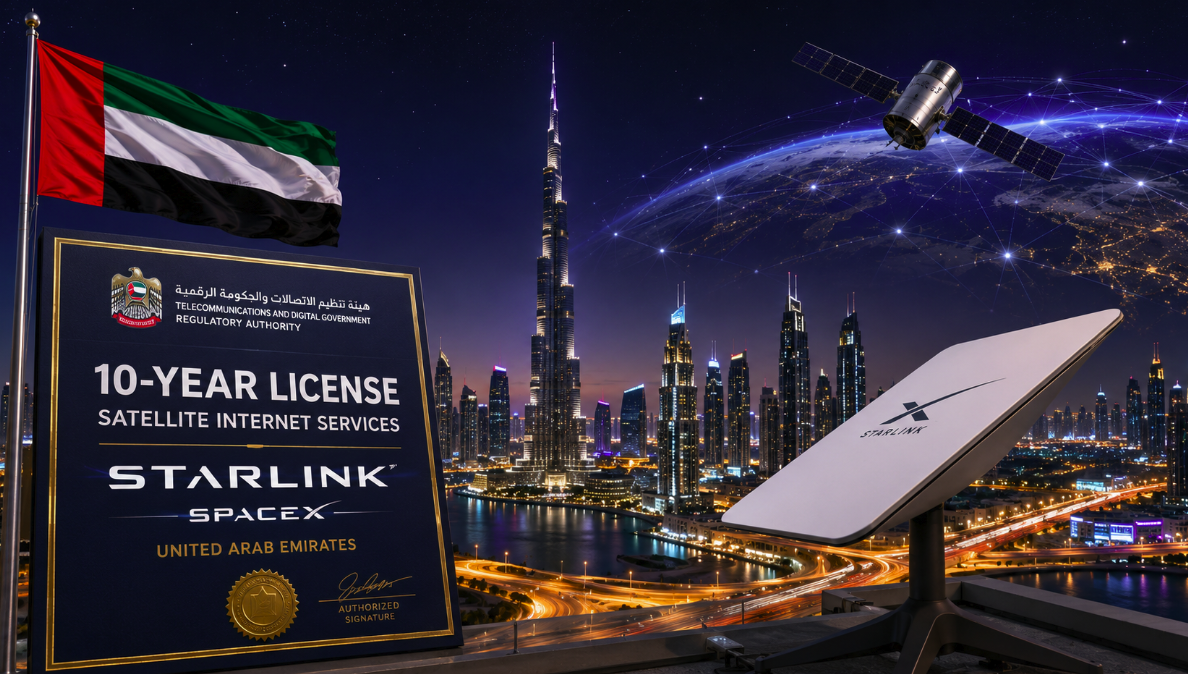
The United Arab Emirates has given Starlink a 10-year license to provide satellite broadband, opening one of the Gulf’s most advanced telecommunications markets to SpaceX’s low-Earth-orbit network. The obvious interpretation is that Elon Musk’s satellite service has gained another national consumer market. The more consequential story is different: the UAE is adding an independently routed space layer to an already highly developed terrestrial network, treating satellite connectivity as part of national resilience rather than simply a solution for places that cannot get broadband.
The UAE Telecommunications and Digital Government Regulatory Authority, or TDRA, announced the license on August 28. Starlink Satellite Communications LLC received a 10-year General Space Services License authorizing it to establish, operate and manage a public satellite communications network and provide broadband satellite internet in the country. The authorization covers consumers, businesses and government entities and extends to maritime and aviation connectivity.
CityBiz reported on the approval as a significant expansion of Starlink’s presence in the Middle East, emphasizing that the service will complement the UAE’s fiber and 5G infrastructure and support critical industries and emergency response. That complementarity is the key to understanding why the license matters: this is not a conventional rural-broadband story.
The UAE does not need Starlink for the usual reason
Satellite broadband is often presented as an answer to geographic isolation. A low-Earth-orbit constellation can connect a home, vessel or remote site without waiting for fiber to reach it or depending on nearby cellular towers. That proposition is compelling in sparsely populated countries and difficult terrain. The UAE, however, has invested heavily in fiber-optic and advanced mobile infrastructure and is already positioning connectivity as a foundation for digital government, smart cities and artificial intelligence.
TDRA explicitly says Starlink will add a space-based layer that complements fiber and 5G. The regulator highlights network resilience, readiness and continuity under different conditions, alongside use in maritime transport, aviation, energy, logistics and emergency response. Those applications reveal the strategic value of the architecture. A satellite connection can follow a physically different path from terrestrial infrastructure and remain available in locations where a fixed line or local mobile network is impractical or disrupted.
Redundancy matters more as economies become more dependent on continuous connectivity. Ports, aircraft, offshore operations, logistics fleets, energy installations and emergency teams do not merely need high peak download speeds. They need communication options when ordinary paths are unavailable. A satellite network cannot eliminate every failure mode, but it can reduce dependence on the same towers, ducts and terrestrial routes used by conventional services.
The timing fits a broader resilience push
The Starlink decision arrives only weeks after TDRA renewed the public telecommunications licenses of e& and du for another 20 years. In its August 12 announcement, the regulator described new obligations around network resilience, backup capacity, geographic diversification of international connectivity, disaster recovery and the elimination of single points of failure.
Read together, the two decisions show a coherent regulatory direction. The UAE is not choosing satellites instead of terrestrial telecom operators. It is broadening the number and type of communications paths available while simultaneously demanding stronger resilience from existing networks. That is increasingly important as telecommunications infrastructure carries not just calls and web traffic but payments, government services, cloud applications, AI workloads and machine-to-machine systems.
The strategy also reflects a shift in what countries consider critical digital infrastructure. For years, national connectivity policy focused on coverage and speed. Those metrics still matter, but availability during disruption is becoming a separate strategic objective. A network that is extremely fast in ordinary conditions can still create systemic risk if too many services depend on the same physical infrastructure.
A 10-year license does not mean an unregulated network
Starlink’s global architecture can create the impression that satellite internet bypasses domestic telecommunications rules. The UAE license makes the opposite clear. TDRA says the services remain subject to national regulatory and technical frameworks covering security, information-infrastructure protection, quality and continuity of service, consumer rights, data privacy, spectrum use and coordination with relevant authorities.
The regulator has also published detailed licensing documentation for satellite internet services. These requirements place the operator inside the UAE telecommunications framework rather than outside it. That is strategically important for governments considering low-Earth-orbit connectivity: the technical network may be global, but market access remains national.
This tension between global infrastructure and national regulation is likely to become more important as satellite constellations expand. Unlike a domestic fiber network, a constellation is shared across countries and controlled through a global fleet of spacecraft, ground stations and software. Governments therefore have to balance the resilience and coverage benefits of satellite connectivity against requirements involving lawful operation, spectrum, cybersecurity and service continuity.
Aviation and maritime services could matter more than home broadband
Residential Starlink attracts the most public attention because the product is tangible: a customer installs a terminal and receives broadband from satellites overhead. In the UAE, however, commercial mobility may be one of the more important opportunities. The license explicitly includes aviation and maritime services, sectors for which terrestrial networks inherently have limited reach.
Modern aircraft increasingly use satellite connectivity for passenger internet and operational communications, while ships require reliable links for crews, logistics, navigation support and business systems. The UAE’s position as an aviation, logistics and maritime hub gives those markets unusual significance. Satellite broadband can extend a digital service environment beyond airports, ports and coastlines into routes where fixed and mobile networks cannot follow.
Energy infrastructure creates another potential use case. Remote installations and offshore assets can require resilient telemetry and communications, sometimes with multiple independent links. Starlink does not automatically become the primary network for those operations, but an additional low-latency satellite option can become part of a layered connectivity design.
Competition will be about architecture as much as price
The arrival of Starlink also changes the competitive landscape without necessarily creating a direct substitute for e& or du. Fiber remains exceptionally well suited to dense urban broadband, while 5G provides mobility and deep integration with national cellular networks. Starlink’s comparative advantage is the ability to establish connectivity without building a physical last-mile route to every location.
That means competition may emerge around use cases rather than a simple price comparison between home internet plans. Businesses could use satellite links for backup connectivity. Temporary projects could connect sites before terrestrial infrastructure is available. Vessels and aircraft can remain online beyond conventional coverage. Government and emergency organizations can maintain alternative communications paths for exceptional circumstances.
The long-term question is whether satellite connectivity becomes a routinely engineered backup layer, much as enterprises already combine multiple cloud regions or internet providers. If it does, Starlink’s value in mature telecom markets may depend less on replacing existing broadband subscriptions and more on reducing the consequences of infrastructure failure.
The UAE is building a network of networks
TDRA describes the Starlink authorization as part of the UAE Digital Agenda and the “We the UAE 2031” vision. The language around diversification and resilience is notable because it treats connectivity as a portfolio of technologies. Fiber, 5G and low-Earth-orbit satellites have different strengths and different failure modes; combining them can create a system that is harder to interrupt than any single network.
There are still practical questions the license announcement does not answer, including consumer launch timing, local plan pricing, hardware availability and how specific services will be integrated with existing operators and regulatory requirements. A license creates the legal foundation for service; it does not by itself tell consumers exactly when every Starlink product will become available.
But the strategic direction is already clear. The UAE has not licensed Starlink because its terrestrial internet infrastructure is inadequate. It has licensed Starlink because sophisticated digital economies increasingly need more than one way to stay connected. In that sense, the most important product SpaceX is selling the UAE may not be faster internet at all. It is another route for information to keep moving when the routes underneath it cannot.