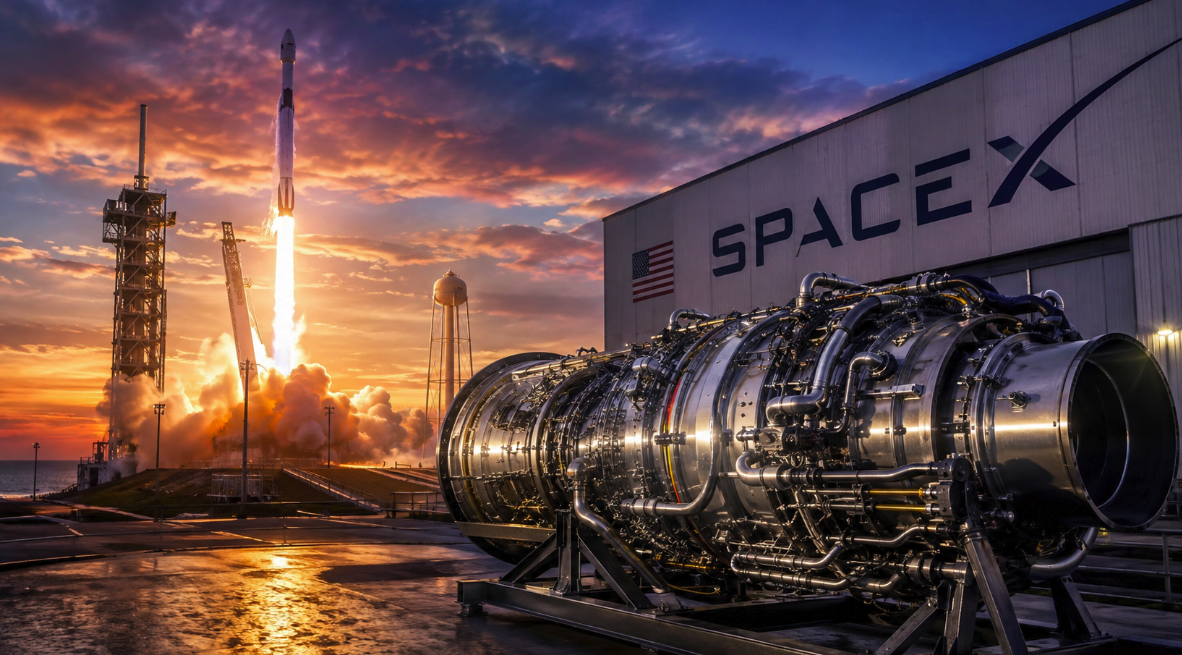
SpaceX is moving into an industrial business that looks far removed from rockets but is increasingly central to the artificial-intelligence boom: gas-turbine manufacturing. Elon Musk said over the weekend that the company plans to produce critical turbine components in-house, including blades and vanes, as developers race to secure enough electricity for new AI infrastructure.
The timing is significant because the constraint facing AI data centers is no longer just access to GPUs. Power-generation equipment, grid connections, transformers and other electrical hardware have become long-lead-time infrastructure. GE Vernova, one of the world's major gas-turbine suppliers, said in July that its gas-power equipment backlog and slot reservation agreements had reached 116 gigawatts and that it was already signing agreements extending into 2031. That turns specialized turbine manufacturing capacity into a strategic bottleneck rather than an obscure corner of the industrial supply chain.
Why SpaceX is interested in turbine blades
According to reports on Musk's announcement, SpaceX intends to establish manufacturing for gas-turbine blades and vanes in Bastrop, Texas. Musk has argued that producing these parts internally could bring turbine deployments forward by as much as 18 months. That is a company claim rather than an independently demonstrated production result, but the underlying constraint is real: turbine makers are carrying unusually large order books as utilities and data-center operators seek additional generation.
Gas-turbine hot-section components are difficult products to manufacture. They operate in extreme temperatures and mechanical conditions and can require advanced alloys, precision casting, cooling passages, coatings and stringent quality control. SpaceX does not automatically become a competitive power-turbine manufacturer simply because it builds rocket engines. But the overlap in high-temperature metallurgy, complex cast components, turbomachinery and vertically integrated production helps explain why Musk sees an opportunity to attack the supply problem internally.
SpaceX's move also fits a broader pattern in Musk-controlled companies: when a supplier or infrastructure dependency becomes a constraint on expansion, the preferred response is often vertical integration. The turbine initiative therefore matters less as a conventional diversification story than as another attempt to turn a supply-chain bottleneck into an internal manufacturing problem.
AI is reshaping the economics of power equipment
The strongest evidence for the bottleneck comes from the established turbine industry. GE Vernova reported that its total company backlog reached $176 billion in the second quarter of 2026. Its gas-power equipment backlog and slot reservations rose from 100 GW to 116 GW sequentially, and the company expects at least 125 GW under contract by the end of the year. GE Vernova also said data-center orders in its Electrification business exceeded $5 billion year-to-date, more than double its 2025 total.
The scale of those commitments illustrates why hyperscalers and AI developers are looking beyond ordinary utility procurement. A data center can be designed and servers can be ordered long before a utility can necessarily provide the required new generation and transmission capacity. On-site or dedicated generation, including natural-gas turbines, can offer another path, although permitting, fuel supply, emissions, noise and local opposition remain important constraints.
Musk has framed natural gas as a bridge rather than an alternative to a longer-term solar-and-storage system. That distinction is important. Building gas generation rapidly can solve an immediate capacity problem, but it also creates assets with operating lives measured in decades. The faster AI infrastructure expands, the more today's temporary power decisions risk becoming tomorrow's installed energy system.
The APR Energy connection makes the strategy clearer
The turbine-component plan follows Musk's move into mobile generation. Reporting in July linked him to the acquisition of APR Energy, an operator of deployable power-generation equipment, in a transaction valued at roughly $1 billion. The combination suggests a strategy that reaches beyond merely purchasing electricity: control more of the chain from generation equipment and deployable capacity to selected critical components.
That approach could give Musk's businesses another lever when grid timelines conflict with AI construction schedules. It does not eliminate the need for turbine OEMs, engineering expertise, gas infrastructure or environmental approvals, and manufacturing a blade is only one part of building a reliable generating plant. But reducing dependence on scarce components could matter when an 18-month difference determines when billions of dollars of computing hardware can start producing useful work.
A rocket launch underscores SpaceX's unusual industrial position
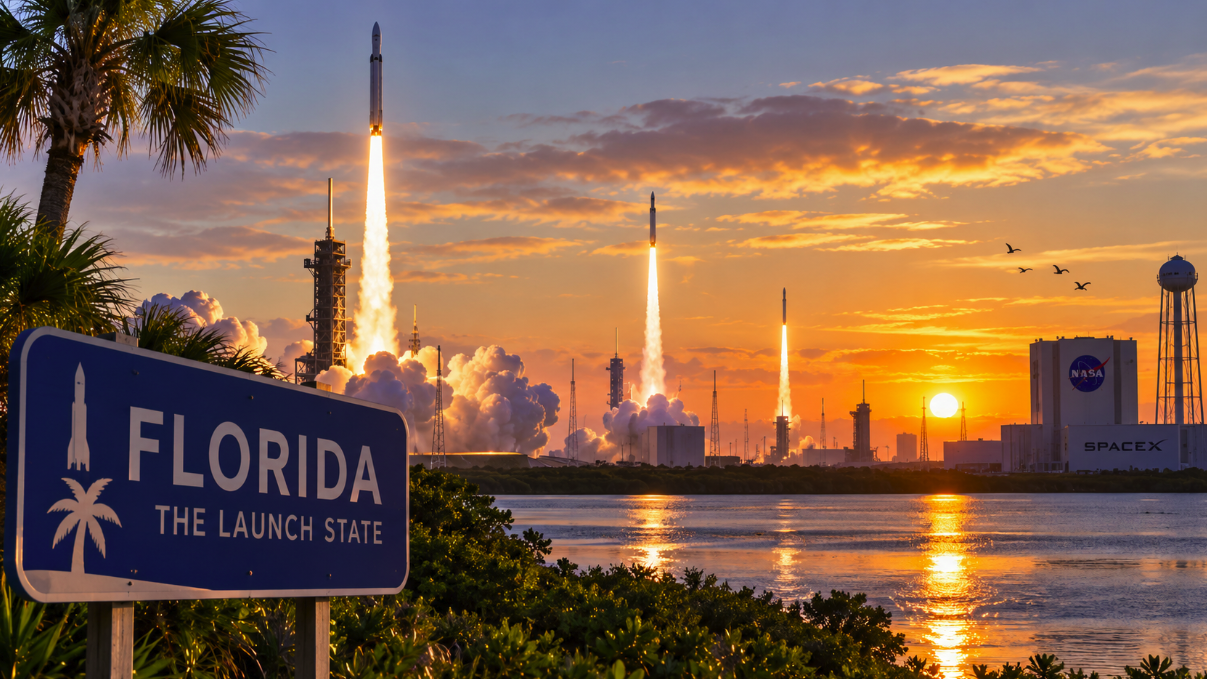
The energy announcement arrived during a weekend that also demonstrated SpaceX's core aerospace role. On August 30, a Falcon Heavy launched NASA's Nancy Grace Roman Space Telescope from Launch Complex 39A at Kennedy Space Center. NASA says Roman is now beginning a roughly three-month, million-mile journey to its operating orbit near the Sun-Earth L2 point.
Roman will use wide-field infrared observations to investigate dark matter, dark energy and exoplanets. Its ability to survey large areas of sky while maintaining high-resolution imaging is intended to complement observatories such as Hubble and the James Webb Space Telescope. The successful launch therefore placed SpaceX simultaneously in two very different infrastructure stories: delivering a flagship scientific observatory to deep space and trying to expand terrestrial power capacity for AI.
Those activities are more connected than they first appear. SpaceX has spent years developing high-throughput manufacturing, propulsion systems, advanced materials and a culture built around shortening hardware iteration cycles. The turbine initiative is a test of whether those capabilities can transfer into a mature industrial sector whose constraints are not only technical, but also regulatory, operational and tied to decades of reliability requirements.
The real test is production, not the announcement
For now, the most important details remain unresolved. SpaceX has not demonstrated at scale that its planned turbine components can shorten delivery schedules, and Musk's 18-month acceleration estimate should be treated as a target rather than a confirmed outcome. Qualification, yield, durability and integration with complete turbine systems will ultimately determine whether the project materially changes the market.
If it succeeds, however, the significance could extend beyond SpaceX. The AI infrastructure race is pushing technology companies deeper into sectors once left to utilities and industrial suppliers. Chips led to data centers; data centers led to power procurement; power shortages are now pulling AI companies toward generation equipment and manufacturing. SpaceX's turbine push is one of the clearest examples yet of that chain reaction, and it suggests that the next competitive advantage in AI may be measured not only in compute, but in how quickly a company can turn fuel, metal and megawatts into dependable electricity.