November 8, 2026 | LMBDA Research & Insights
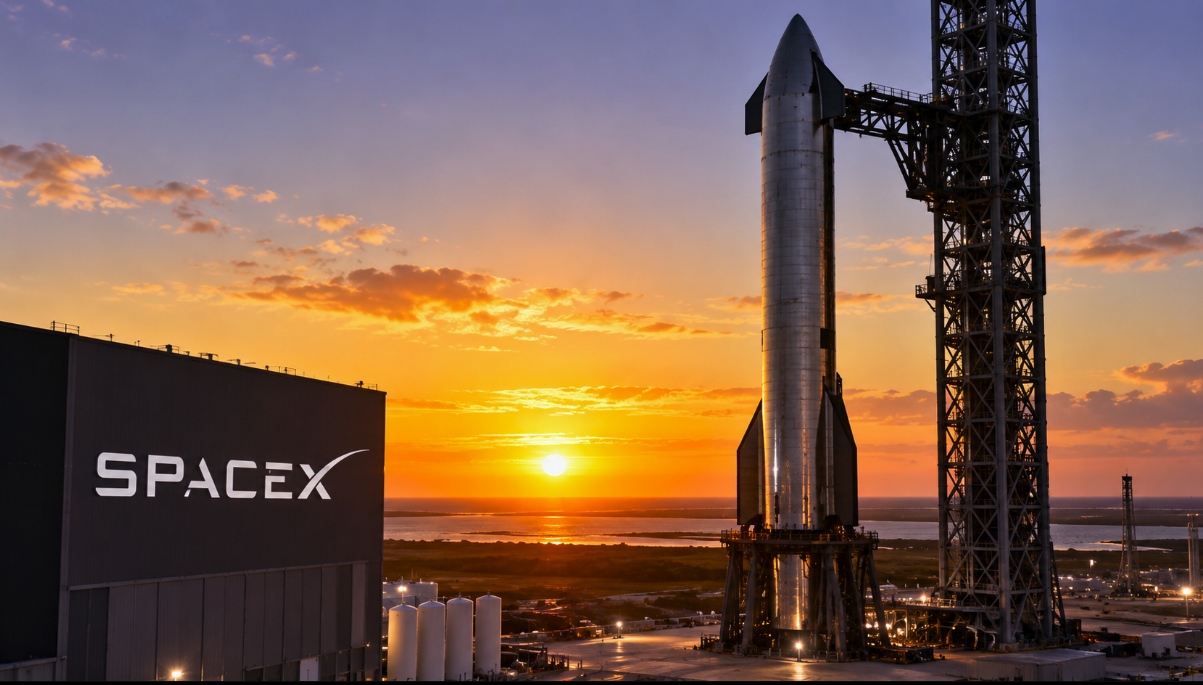
SpaceX is preparing Starship for its most ambitious recovery attempt so far. Flight 15 is expected to attempt something the programme has never achieved: bringing both the Super Heavy booster and the Starship upper stage back to the launch site for capture by the tower's mechanical arms.
Elon Musk outlined the dual-catch objective during SpaceX's third-quarter 2026 earnings call on October 20. He said the company expected the flight in November and described full recovery of an orbital launch vehicle as a major technology milestone. He also cautioned that success was not guaranteed, although he considered it more likely than not on the first attempt.
A more specific date has since emerged. SpaceX vice president of launch Kiko Dontchev reportedly said at the UP.Summit on November 5 that the company was targeting Friday, November 13, 2026. That date is a reported target, not a confirmed launch appointment published on a SpaceX mission page. The final schedule remains dependent on regulatory approval and operational readiness.
The first attempt to catch Starship itself
SpaceX has already demonstrated that it can catch a Super Heavy booster with the launch tower's large mechanical arms, commonly called the chopsticks. Flight 5 achieved the first booster catch in October 2024, and subsequent flights repeated the recovery. The upper stage, however, has so far ended its missions with controlled splashdowns rather than a return to the launch tower.
Flight 15 is designed to test the next step: catching the Ship as well as the booster. The two vehicles would follow different return trajectories and arrive at the tower at different stages of the mission. Each recovery requires precise guidance, control, engine performance and coordination with the ground systems.
The Ship catch is especially demanding because the upper stage must return from orbital velocity. It has to survive atmospheric re-entry, manage its thermal loads, control its descent and reach the tower within the capture envelope. The booster catch is already a demonstrated capability, but repeating it as part of a mission that also attempts Ship recovery adds operational complexity.
Why full reusability changes the economics of launch
Today's orbital launch systems generally recover and reuse some hardware, but the upper stages are typically expended. Starship is being developed around a more ambitious model: reuse both stages, with rapid turnaround between flights.
Recovering the Ship could change the economics of the programme if the vehicle can be inspected, refurbished and reflown without a lengthy rebuild. It could also reduce the cost and manufacturing burden associated with producing a new upper stage for every mission.
However, a successful catch would be only the first step. The vehicle would still need post-flight inspection, maintenance and validation before another launch. Reusability is not measured solely by whether a rocket returns intact; the time, labour and cost required to prepare it for another mission are equally important.
That is why Musk's ambition extends beyond a single dramatic recovery. During the October earnings call, he said SpaceX wanted a steady stream of Starship flights and was aiming for weekly launches during the first half of 2027, potentially increasing to twice a week or more by the end of that year. Those are company targets, not an established launch cadence.
Flight 14 established the orbital baseline
The previous mission, Starship Flight 14, lifted off from Starbase, Texas, on September 28, 2026. SpaceX described it as the vehicle's first orbital flight and the first mission to deliver a meaningful payload to orbit. The Ship deployed 26 Starlink V3 satellites.
The mission also demonstrated important parts of the return sequence. Super Heavy completed its ascent and stage-separation operations before performing a controlled descent and splashdown in the Gulf. Starship reached orbit and later completed a controlled re-entry and splashdown in the Pacific.
Flight 14 was not flawless. SpaceX's mission report records an engine shutdown during the booster's ascent, while Reuters reported that an engine on the Ship shut down prematurely after separation. The mission was shortened, but the remaining engines enabled the vehicle to reach orbit and deploy its payload.
Those results matter for Flight 15 because a tower catch requires more than reaching the intended trajectory. The vehicle must retain sufficient control authority and propulsion performance throughout the return sequence. The previous flight provided valuable data, but it did not demonstrate a Ship recovery.
The regulatory hurdle: a return to the launch site
The planned dual catch also requires the appropriate launch and return authorisations. SpaceX president Gwynne Shotwell said during the October earnings call that the company had held constructive discussions with the Federal Aviation Administration and expected the Flight 15 licence to include a return to the launch site and tower catches for both stages.
That expectation should not be confused with a final licence already issued. The return profile is more demanding than a mission that ends with splashdowns at sea. It requires the regulator to assess the flight path, the risks associated with returning large vehicles over land, public safety measures and the planned recovery operations at Starbase.
As of the latest reporting available on November 8, the public material reviewed for this article did not establish that the final Flight 15 authorisation covering both catches had been published. The November 13 date should therefore be treated as a target that may move if regulatory or technical work requires more time.
What the tower catch actually involves
The launch tower's two large arms are designed to capture a returning vehicle at designated structural points. The system must position the arms accurately as the vehicle approaches and transfer the vehicle's weight safely to the tower.
For the Ship, the challenge is not simply slowing down. It must arrive in a controlled orientation and at a speed and position compatible with the capture mechanism. The vehicle's guidance system, propulsion, aerodynamic control surfaces and ground-based tracking all contribute to the final manoeuvre.
A successful catch would validate a major part of the recovery architecture, but it would not by itself demonstrate rapid reusability. Engineers would still need to establish the condition of the heat shield, engines, structure and other systems after flight, and determine how much work is required before another launch.
Why the mission matters beyond the launch programme
Starship is central to several of SpaceX's longer-term plans. A reusable heavy-lift system could increase the amount of cargo delivered to orbit, support the deployment of larger satellite constellations and eventually enable missions beyond Earth orbit.
Starlink is an immediate beneficiary of higher launch capacity. The deployment of Starlink V3 satellites on Flight 14 demonstrated how Starship could contribute to the next phase of the constellation. A vehicle that can fly more often and carry large payloads could make satellite deployment more flexible, although the operational and economic benefits depend on achieving reliable reuse.
NASA's lunar programme is another important connection. Starship has been selected as the Human Landing System for the Artemis programme, and the ability to refuel and operate the vehicle in space is central to the planned lunar architecture. A successful tower catch would not solve the separate challenges of orbital refuelling, life support, lunar landing or crew safety, but it would advance the reusable launch system on which those plans depend.
What to watch on Flight 15
- Launch authorisation: whether the FAA issues the licence needed for the planned return-to-site profile and both tower catches.
- Booster recovery: whether Super Heavy repeats its previously demonstrated return and catch sequence.
- Ship re-entry: whether the upper stage survives the thermal and aerodynamic loads of its return from orbit.
- Ship capture: whether the vehicle reaches the tower in the correct position and can be secured by the chopsticks.
- Post-flight condition: whether the recovered hardware can be inspected and prepared for another flight, and how much refurbishment is required.
- Schedule and cadence: whether the mission supports SpaceX's stated ambition to increase flight frequency during 2027.
Frequently asked questions
When is Starship Flight 15 scheduled to launch?
SpaceX is reportedly targeting Friday, November 13, 2026, following remarks by launch vice president Kiko Dontchev at the UP.Summit. The date is a target rather than a final official launch appointment, and it remains subject to regulatory approval and operational readiness.
What is the main objective of Flight 15?
The mission is expected to attempt the first tower catch of the Starship upper stage while also attempting to catch the Super Heavy booster. SpaceX has caught boosters before, but it has not yet caught a Ship returning from orbit.
Has SpaceX caught a Starship booster before?
Yes. SpaceX first caught a Super Heavy booster with the launch tower during Flight 5 in October 2024 and repeated the achievement on later flights. Flight 15 would add the first attempted Ship catch.
Why is catching the Ship more difficult?
The upper stage must return from orbital velocity, survive atmospheric re-entry and perform a controlled descent to a precise capture point. Its heat shield, structure, propulsion and guidance systems must all perform as required.
Does a successful catch mean Starship is fully reusable?
It would demonstrate a major recovery capability, but operational reusability also requires inspection, maintenance and a practical turnaround process. A vehicle that is recovered but needs extensive refurbishment may not achieve the rapid launch cadence SpaceX wants.
Has the FAA approved the dual catch?
SpaceX said it expected the Flight 15 licence to include return to launch site and catches of both stages. The final authorisation should be checked against the FAA's published licensing information; an expectation expressed by the company is not itself regulatory approval.
What happened on Starship Flight 14?
Flight 14 launched on September 28, 2026, reached orbit and deployed 26 Starlink V3 satellites. Both stages completed controlled splashdowns, but neither was recovered by the launch tower.
How often does SpaceX want to fly Starship in 2027?
Elon Musk said the company was targeting weekly flights during the first half of 2027 and potentially twice-weekly flights or more by the end of the year. These are ambitions that depend on technical progress, regulatory approvals and operational readiness.
Conclusion: the real milestone is a vehicle that can fly again
Starship Flight 15 is important because it moves the programme's central promise—full and rapid reusability—into a new phase. Catching Super Heavy has already become a repeatable demonstration. Catching the Ship would test whether the same recovery philosophy can be extended to the upper stage after an orbital mission.
The November 13 target gives the next test a clear focus, but the date is not yet equivalent to a final launch confirmation. The FAA authorisation, the condition of the flight hardware and the complexity of the return sequence remain decisive.
If SpaceX can recover both stages and turn that recovery into a repeatable operating process, Starship will move closer to changing the economics of access to orbit. Flight 15 could be a major step—but the proof will be measured in safe recoveries, inspections and successful reflights, not in one spectacular catch alone.
Sources
- SpaceX — Starship Flight 14, mission report (September 28, 2026).
- SpaceX Investor Relations — Q3 2026 Earnings Call and materials (October 20, 2026).
- SpaceX Q3 2026 earnings call transcript — Flight 15 objectives and cadence targets.
- Space.com — SpaceX will attempt the first double Starship rocket catch (October 20, 2026).
- TeslaNorth — SpaceX targets November 13 for Starship Flight 15 (November 5, 2026), reporting Kiko Dontchev's UP.Summit remarks.
- Reuters — Starship reaches orbit and deploys 26 Starlink satellites on Flight 14 (September 28, 2026).