November 8, 2026 | LMBDA Research & Insights
SpaceX is moving beyond satellite connectivity and into the infrastructure of the traditional mobile industry. On November 4, Qualcomm announced that SpaceX had selected its Dragonwing cellular infrastructure platforms for Starlink Mobile's planned nationwide terrestrial 5G network in the United States. The multi-year agreement covers radio and baseband technology, commercial-grade Layer 1 software and deployment across tens of thousands of sites, with the rollout expected to begin in 2027.
The announcement is a concrete step in SpaceX's ambition to combine satellite coverage with a ground-based mobile network. It does not mean Starlink Mobile is already a nationwide carrier, nor does it establish when consumers will be able to buy a fully integrated service. It does show that the company is preparing to build a terrestrial radio access network at a scale that would put it in more direct competition with AT&T, Verizon and T-Mobile.
What Qualcomm will supply
According to Qualcomm's November 4 announcement, SpaceX selected two platforms from its Dragonwing Cellular Infrastructure portfolio: the QRU100 and QDU100. They are intended to provide key building blocks for Starlink Mobile's terrestrial base stations.
The QRU100 supports processing in the radio unit, while the QDU100 is designed for high-performance, latency-sensitive Layer 1 processing in the distributed unit. Qualcomm is also supplying commercial-grade Layer 1 software. In a mobile network, Layer 1 is the physical layer: it handles the radio signal processing that allows devices and base stations to transmit and receive data over the air.
The planned radio architecture uses Massive MIMO with 64 transmit and 64 receive paths (64T64R). Multiple antenna paths allow a base station to serve users and manage radio resources more efficiently. Qualcomm says the design is intended to improve coverage, capacity and spectral efficiency, while reducing power consumption per unit of processing.
The agreement's financial terms were not disclosed. Qualcomm described it as its largest 5G deal to date. Reuters independently reported the multi-year arrangement and the plan to deploy equipment across tens of thousands of US macro cell sites beginning in 2027.
A hybrid network: satellites for reach, towers for capacity
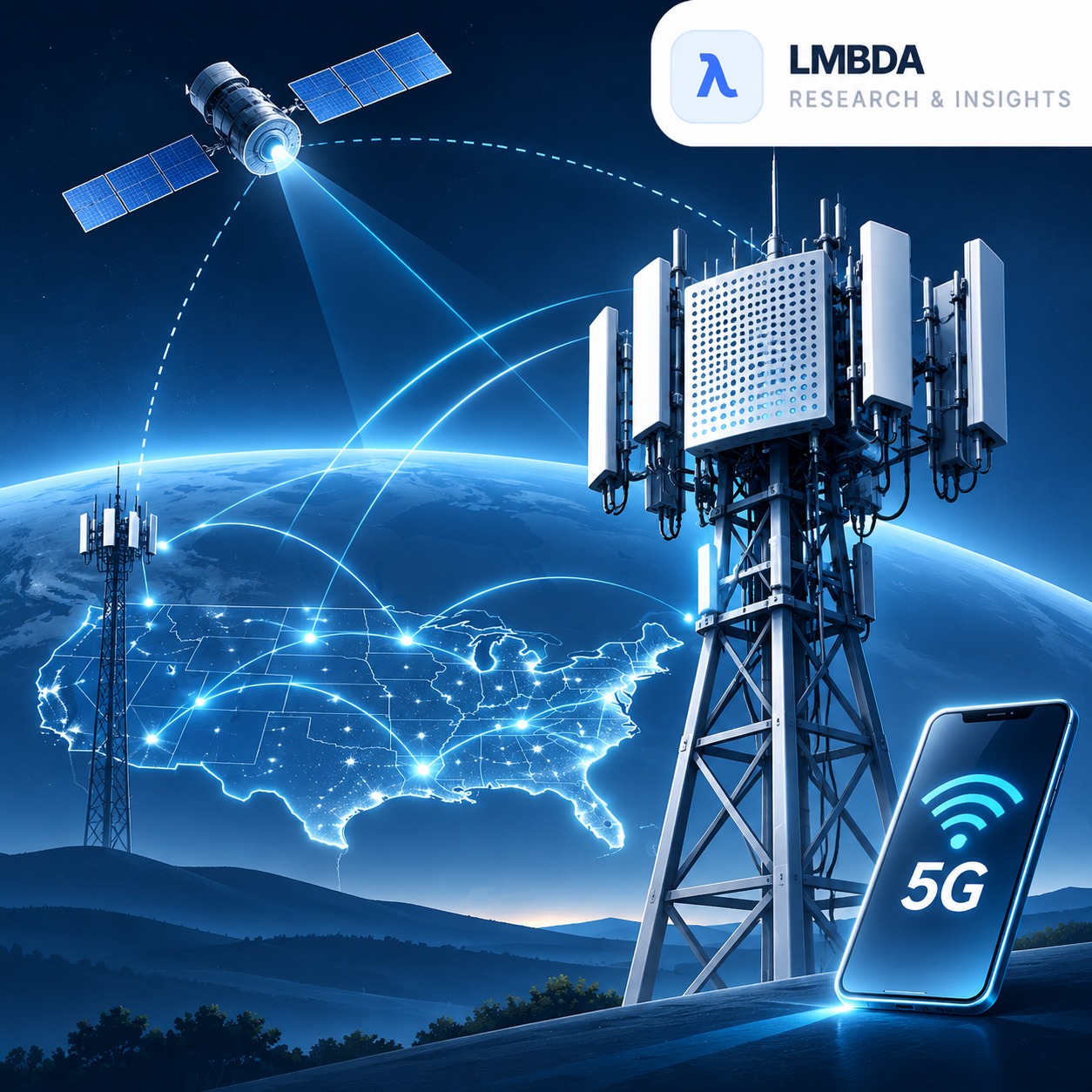
Starlink Mobile's terrestrial build-out is designed to complement its satellite direct-to-cell capabilities, rather than replace them. The two layers solve different connectivity problems.
Satellite links can extend connectivity to areas where conventional mobile coverage is unavailable or unreliable, including remote locations and some emergency situations. Terrestrial cellular sites can provide additional capacity in towns, cities, transport corridors and other places where many users are concentrated. A hybrid architecture could use satellites to extend reach and ground infrastructure to handle higher traffic loads where demand justifies the investment.
That distinction is central to SpaceX's strategy. Satellite connectivity alone has physical and spectrum constraints when it comes to serving dense populations with the capacity expected from a conventional mobile network. A large terrestrial footprint would give Starlink Mobile another way to serve users while retaining the reach of its satellite constellation.
Seamless handoff between satellite and terrestrial networks is an ambition, not something established by the Qualcomm announcement as a universally available customer feature. It will depend on device compatibility, spectrum arrangements, network architecture, roaming and interconnection agreements, and regulatory approvals.
Spectrum is a strategic asset—and a constraint
A mobile operator needs more than radios and cell sites. It needs access to licensed spectrum, the frequencies used to carry wireless signals. SpaceX has been assembling spectrum resources as part of its broader mobile strategy.
In May 2026, the Federal Communications Commission granted applications connected with the transfer of EchoStar's AWS-4, AWS H-Block and unpaired AWS-3 spectrum licences to SpaceX through a two-step transaction. EchoStar's regulatory filings describe 50 MHz associated with the AWS-4 and H-Block licences in the relevant transaction. These documents provide a more reliable basis for describing the spectrum than broad rounded figures that combine different bands or transactions.
Low-band frequencies can be useful for wider-area coverage and indoor penetration, while mid-band spectrum can provide a balance of coverage and capacity. Actual performance depends on the frequencies, channel bandwidth, propagation conditions, antenna configuration, interference environment and the amount of spectrum available in each market.
SpaceX's spectrum position should not be treated as equivalent to that of the established US carriers. The amount of usable spectrum, its geographic rights, the technical conditions attached to licences and the ability to combine it with other bands will all affect the network's capacity and economics. Spectrum holdings are an important foundation, but they do not by themselves create a nationwide mobile service.
Why the Qualcomm deal matters for the telecom supply chain
Qualcomm is best known for processors and connectivity technology in smartphones. The Dragonwing agreement expands its role into the infrastructure used by cellular operators. Instead of supplying only components inside devices, Qualcomm is providing radio and baseband building blocks for a large network deployment.
That puts the company in a more direct infrastructure conversation with established telecom equipment suppliers and semiconductor companies. It also demonstrates that the cellular radio access network is an area where specialised silicon, software and power efficiency can influence the economics of large-scale deployment.
For SpaceX, selecting an established supplier may help reduce the engineering burden associated with building a nationwide radio network. But Qualcomm's platforms are components of a larger system. SpaceX will still need to integrate the equipment with its own network software, spectrum, core network, satellite systems, devices and operational processes.
Can SpaceX really challenge AT&T, Verizon and T-Mobile?
The agreement makes the competitive ambition more tangible, but the scale of the challenge remains substantial. The three established US mobile operators already operate extensive radio networks, have long-standing customer relationships, manage retail and enterprise distribution, and have mature billing, customer-support and roaming arrangements.
Building tens of thousands of sites is only one part of the task. SpaceX will need suitable locations, backhaul, power, construction capacity, site leases, permits and ongoing maintenance. It will also need to deliver reliable service indoors and in high-traffic areas, where customers expect consistent performance rather than occasional connectivity.
Commercial success will depend on more than headline coverage. Pricing, compatible devices, customer acquisition costs, network quality, spectrum efficiency and the terms of any partnerships with existing operators will all influence whether subscribers switch. The Qualcomm announcement does not disclose the network's final retail pricing, launch timetable for individual markets or a complete consumer service plan.
Reuters noted that the financial terms of the Qualcomm deal were not disclosed. That makes it difficult to estimate the equipment commitment or the full capital expenditure required for the terrestrial network. Tens of thousands of sites imply a major multi-year investment, but a reliable total cannot be calculated from the announcement alone.
From satellite broadband to control of the connectivity stack
SpaceX's broader strategy is increasingly about integrating several layers of connectivity: spectrum rights, satellites, launch capability, user terminals and now terrestrial radio infrastructure. Greater control over these layers could give the company more flexibility in how it designs and distributes connectivity services.
Vertical integration can create advantages, but it also concentrates investment and operational responsibility. SpaceX would have to manage a much larger set of relationships with tower owners, utilities, equipment suppliers, regulators and customers. It would also compete in a market where established operators have years of experience optimising spectrum, coverage and network costs.
The strategic opportunity is not limited to replacing a conventional phone plan. A combined satellite and terrestrial network could be relevant to connected vehicles, remote industrial operations, emergency communications and devices that move between areas with different coverage conditions. These are potential applications, not proof that every use case is already commercially supported.
AI-native 6G: a direction, not a product launch
Qualcomm described the collaboration as a commercial step toward a broader vision of AI-native 6G infrastructure. That language deserves careful interpretation. The announced deployment is a terrestrial 5G network. The companies are positioning the architecture as a foundation that could evolve toward future connectivity systems in which computing and AI are more deeply integrated into network management and operation.
AI could eventually support functions such as traffic prediction, resource allocation, energy optimisation, anomaly detection and network automation. But the announcement does not describe a deployed 6G network, a final 6G standard or a specific AI feature that customers can use today. It is a statement about the direction of future infrastructure development.
The distinction matters because the telecom industry is already using AI in network operations, while the standards and architecture for 6G continue to evolve. A supplier's reference to AI-native 6G should not be confused with a commercial 6G service being launched alongside this 5G agreement.
What happens next?
The first major milestone is the planned start of deployment in 2027. Between now and then, the key questions are how quickly SpaceX can finalise network design and site access, how the radio equipment will be integrated with its spectrum and core network, and what regulatory steps remain before commercial service can scale.
- Deployment: whether the first sites enter construction and service on the announced 2027 timetable.
- Network footprint: how many sites are deployed in each phase and which regions receive coverage first.
- Spectrum: how SpaceX combines its licensed holdings and manages the technical and regulatory conditions attached to them.
- Device support: which smartphones and other devices can use the terrestrial and satellite layers, and whether existing devices require new hardware.
- Service integration: how handoff, roaming, emergency connectivity and customer authentication will work in practice.
- Economics: the cost of site deployment, power, backhaul, maintenance and customer acquisition compared with expected revenue per subscriber.
Frequently asked questions
What did SpaceX announce with Qualcomm on November 4, 2026?
SpaceX selected Qualcomm Dragonwing QRU100 and QDU100 cellular infrastructure platforms and commercial-grade Layer 1 software for Starlink Mobile's planned US terrestrial 5G network.
When will Starlink Mobile's terrestrial 5G rollout begin?
Qualcomm says deployment is expected to begin in 2027, with tens of thousands of sites planned under a multi-year agreement. This is a deployment plan, not confirmation that nationwide consumer service will be available in 2027.
What is 64T64R Massive MIMO?
It is a radio configuration with 64 transmit and 64 receive paths. Massive MIMO uses multiple antenna elements to manage radio signals and serve users more efficiently, with the aim of improving capacity, coverage and spectral efficiency.
Will terrestrial 5G replace Starlink direct-to-cell?
No. The announced terrestrial network is intended to complement satellite connectivity. Ground sites can add capacity where demand is high, while satellites can extend reach beyond conventional cell coverage.
Which Qualcomm platforms will Starlink Mobile use?
The announced platforms are Dragonwing QRU100 for radio-unit processing and QDU100 for distributed-unit Layer 1 processing, supported by commercial-grade Layer 1 software.
Is Qualcomm's deal the largest 5G agreement in its history?
Qualcomm described the agreement as its largest 5G deal to date. The companies did not disclose the financial terms.
Does this mean SpaceX is already a nationwide mobile carrier?
No. The agreement supports a planned network build-out. Nationwide coverage, commercial availability, device compatibility and customer pricing remain matters to be established as deployment progresses.
What does AI-native 6G mean in this announcement?
It refers to a longer-term infrastructure vision in which AI and computing are integrated more deeply into future networks. The announced project is a 5G deployment, not a 6G launch.
Can SpaceX compete with AT&T, Verizon and T-Mobile?
It is positioning itself to compete, but success will depend on spectrum, site density, network performance, capital investment, device support, pricing and customer acquisition. The Qualcomm deal is an important step, not proof that the competitive challenge has already been solved.
Conclusion: Starlink Mobile is moving from coverage extension to network competition
The Qualcomm agreement changes the scale of SpaceX's mobile ambitions. Starlink Mobile is no longer being framed only as a satellite layer that helps users connect beyond the reach of conventional towers. The company is preparing to build a terrestrial 5G network with tens of thousands of sites, using commercial radio and baseband platforms from a major technology supplier.
The hybrid model could combine satellite reach with the capacity of ground-based networks. But the difficult work lies ahead: spectrum deployment, site acquisition, integration, capital expenditure, regulatory compliance and convincing customers that a new operator can match the reliability of established carriers.
The November agreement is a meaningful infrastructure milestone. Whether it becomes a genuine challenge to the US mobile incumbents will be decided by the network SpaceX actually builds—not by the ambition described in the announcement.
Sources
- Qualcomm — SpaceX Selects Qualcomm to Accelerate Starlink Mobile's Nationwide 5G Network (November 4, 2026).
- Reuters — Qualcomm signs major 5G infrastructure deal with SpaceX for Starlink Mobile network (November 4, 2026).
- Federal Communications Commission — SpaceX–EchoStar spectrum transaction decision (May 2026).
- EchoStar — Form 10-Q, spectrum transaction disclosures (2026).
- Teslarati — SpaceX moves to challenge AT&T, Verizon with Qualcomm-powered 5G (November 2026).