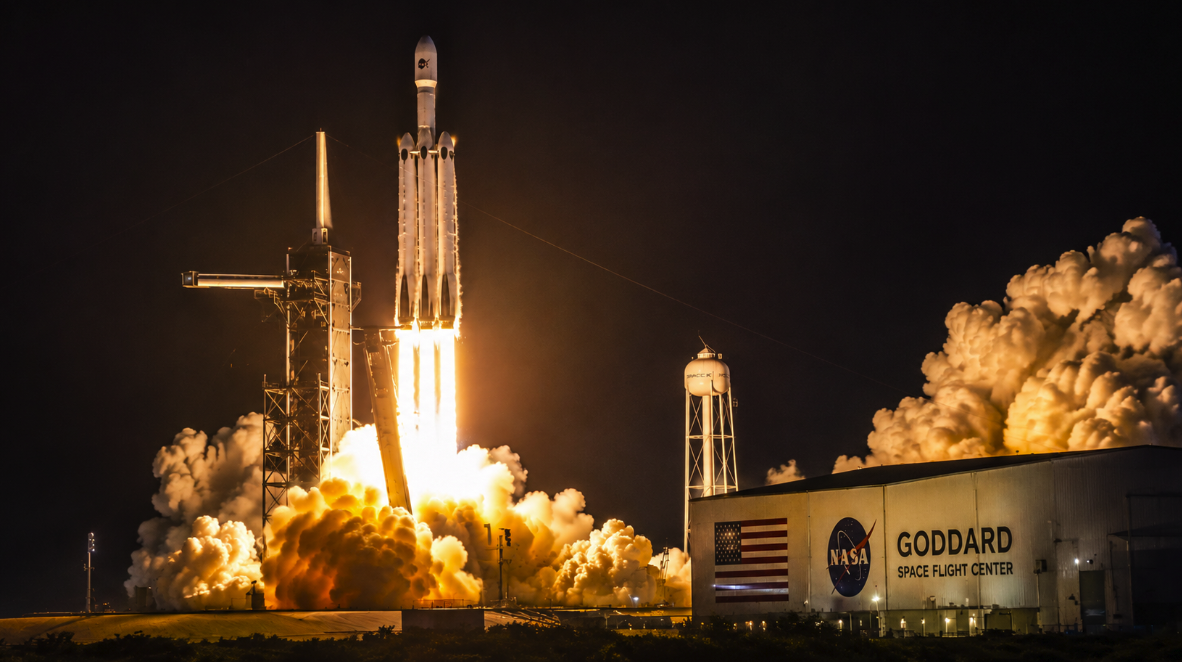
NASA’s Nancy Grace Roman Space Telescope successfully left Earth on Sunday, August 30, beginning a mission that could dramatically expand the scale of infrared sky surveys. A SpaceX Falcon Heavy lifted off from Launch Complex 39A at Kennedy Space Center at 7:26 a.m. EDT, and Roman separated from the rocket’s second stage at 7:58 a.m. EDT.
The launch itself went cleanly, but Roman is not yet an operational space telescope. NASA says the spacecraft is beginning an approximately three-month commissioning period as it travels roughly 1 million miles toward an orbit around the second Sun-Earth Lagrange point, L2. That phase — deployments, activation, calibration and testing — is now the mission’s immediate challenge.
Roman established communications through NASA’s Tracking and Data Relay Satellite system shortly before spacecraft separation. The observatory was then scheduled to deploy its six-panel Solar Array Sun Shield, a system that both supplies electrical power and helps keep the spacecraft thermally stable.
The distinction between a successful launch and a successful observatory matters. Roman’s scientific promise depends on a combination of large optics, a huge field of view and an unusually demanding data pipeline. Getting that system working together in space is what the next several months are about.
A flagship telescope built to survey, not just zoom in
Roman has a 2.4-meter primary mirror, comparable in diameter to Hubble’s, but it is designed for a fundamentally different style of observing. Its Wide Field Instrument can capture far larger areas of the sky in a single exposure. NASA says Roman combines crisp infrared imaging with a field of view at least 100 times larger than Hubble’s for comparable observations.
That makes Roman less a replacement for Hubble or the James Webb Space Telescope than a new counterpart to them. Webb is exceptionally powerful when astronomers need detailed observations of selected objects. Roman is designed to survey broad regions efficiently, identifying huge populations of galaxies, stars and planetary systems that can then be studied statistically or followed up by other observatories.
NASA expects Roman’s wide-field surveys to investigate dark energy, map the distribution of matter across cosmic history and search for exoplanets. During launch coverage, NASA officials emphasized the sheer scale of the catalogs Roman is expected to produce. Its survey of the Milky Way alone is intended to observe enormous stellar populations toward the galactic center.
The mission will also use gravitational microlensing to detect planets. Microlensing occurs when the gravity of a foreground star — and potentially planets around it — bends and magnifies light from a more distant background star. Roman’s ability to monitor dense star fields repeatedly should make it possible to build a statistical census of planetary systems that complements discoveries made by transit and radial-velocity surveys.
Roman’s second instrument, the Coronagraph Instrument, is a technology demonstration developed with major involvement from NASA’s Jet Propulsion Laboratory. It is designed to suppress the overwhelming glare of stars so much fainter nearby objects can be observed. The coronagraph is not Roman’s primary science instrument, but demonstrating advanced starlight suppression in space could inform future missions intended to directly image planets around other stars.
Falcon Heavy completed the first critical step
Roman’s departure began with Falcon Heavy’s three-core first stage. NASA reported that the rocket’s 27 Merlin engines generated more than 5 million pounds of thrust at liftoff. The two side boosters separated during ascent and returned to landing zones in Florida, while the center core continued carrying the upper stage and Roman toward space.
After center-core separation, Falcon Heavy’s upper stage continued the mission and its payload fairing was discarded once it was no longer needed. The upper stage performed the planned burns before Roman separated and began flying independently.
The mission is now heading toward L2, the same general Sun-Earth gravitational region used by Webb. Operating there gives infrared observatories a useful environment for thermal stability and a relatively consistent geometry with the Sun and Earth.
Roman itself is a substantial spacecraft. NASA says the fully deployed observatory is more than 42 feet long and more than 14 feet wide, with a launch mass of roughly 18,000 pounds. Its six solar-array panels are designed to provide about four kilowatts of power.
Roman’s data volume could change how astronomers use a flagship mission
One of the most consequential numbers associated with Roman is not its mirror diameter but its expected communications load. NASA says the telescope will downlink approximately 1.4 terabytes of science data per day once operations begin. Ground systems will use Ka-band communications at rates up to 500 megabits per second, with stations distributed across New Mexico, Australia and Japan and additional international support.
That data rate reflects the mission’s basic philosophy: Roman is intended to produce enormous, systematic datasets rather than only a collection of individually targeted observations. Such archives can remain scientifically valuable long after the observations are taken because researchers can search them for phenomena that were not necessarily the original reason for collecting the data.
Wide surveys can expose rare objects precisely because they cover so much territory. Unexpected transients, unusual gravitational lenses, faint galaxies, black holes and stellar populations can emerge from datasets created for other investigations. Roman therefore has the potential to function as both an observatory and a discovery engine feeding targets to other telescopes.
This also makes the ground segment unusually important. A telescope capable of producing terabytes of observations is only as useful as the systems that transmit, calibrate, process, archive and distribute those observations to scientists.
Roman’s successful launch has removed one of the mission’s largest single risks, but it has not yet proven the observatory. NASA’s teams must now shepherd the spacecraft to L2 and verify that its thermal, power, pointing, communications and instrument systems work together under flight conditions.
If commissioning succeeds, Roman will enter science operations with a capability that has been missing from NASA’s flagship observatory fleet: Hubble-class sharpness combined with a panoramic infrared view built for repeated surveys. The spectacular Falcon Heavy launch was the visible beginning. The quieter engineering work over the next three months will determine whether Roman can actually deliver the enormous map of the universe it was built to make.