Europe has approved the mission that could put its first rover on the Moon in 2029, but MAGPIE is more than a small machine hunting for ice near the lunar south pole. The mission is also a test of whether the European Space Agency can change how it builds exploration hardware: smaller missions, commercial prime contractors and faster development cycles instead of relying exclusively on the long timelines traditionally associated with flagship space programs.
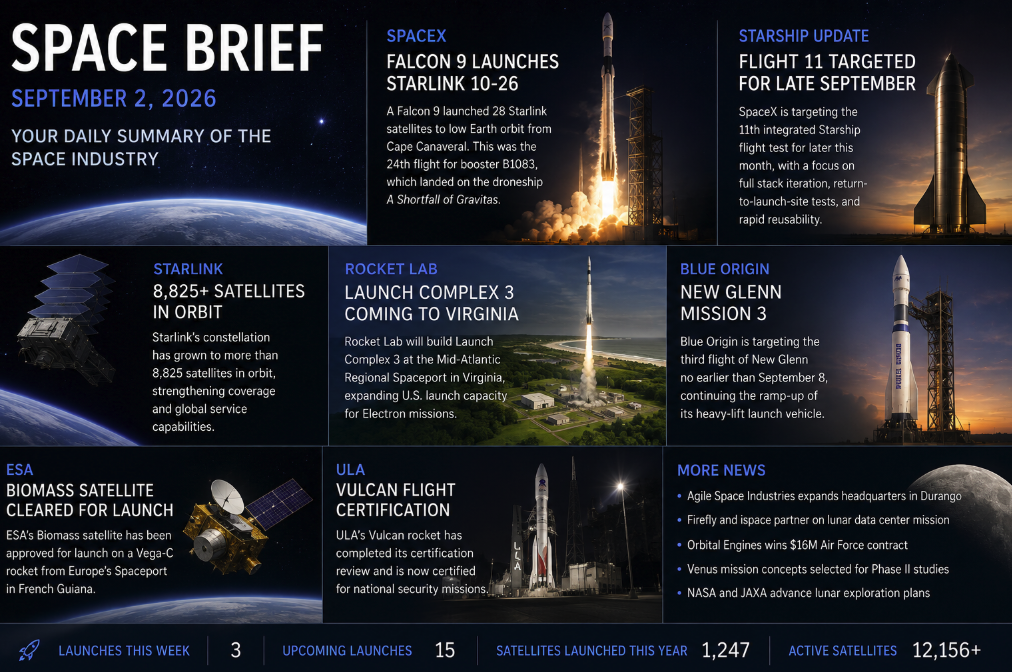
The milestone leads KeepTrack's September 2 Space Brief. ESA and ispace-Europe marked the implementation agreement for MAGPIE — the Mission for Advanced Geophysics and Polar Ice Exploration — at the Space for Inspiration event in Copenhagen. The rover is scheduled to fly to the lunar south polar region aboard ispace's Mission 4 lander in 2029, with transportation enabled through cooperation between ESA and Japan's JAXA.
The science objective is familiar because it sits at the center of almost every major plan for sustained lunar exploration: determine where water and other volatiles exist, how they are distributed and what lies beneath the surface. The institutional experiment is less obvious. ESA is explicitly describing MAGPIE as its first lunar “small mission,” designed around a faster and lower-cost model intended to create capabilities Europe can reuse on future missions.
MAGPIE is a €65 million experiment in doing lunar missions differently
ESA awarded ispace-Europe a €65 million Phase 2 contract in July, covering the remaining delivery of the mission. According to ispace's September 2 announcement, the contract includes rover and payload development, manufacturing, testing, transportation to the lunar surface, mission operations and delivery of the scientific data to ESA.
That scope is significant. Luxembourg-based ispace-Europe is not merely manufacturing a rover to an agency specification and handing it over. ESA selected the company as mission prime, giving it responsibility across much of the end-to-end mission. The consortium includes institutions in Germany, the United Kingdom and Norway, while the rover will ride on a Japanese company's commercial lunar lander through an ESA-JAXA collaboration.
This is a structure increasingly familiar in the United States, where NASA has used commercial contracts to buy lunar transportation and other services. For ESA, MAGPIE represents an attempt to apply more of that logic to lunar science and exploration. The agency says the Moon Explore initiative is intended to develop important capabilities more quickly and efficiently, enabling more frequent missions rather than concentrating resources only in large, slow programs.
The trade-off is clear. Smaller commercial missions can move faster and distribute risk across multiple attempts, but they also depend on suppliers and transportation systems that may have less flight heritage than traditional government-led architectures. MAGPIE's success will therefore be measured not only by the science it returns but by whether this development model proves repeatable.
The rover has only about 10 Earth days to work
MAGPIE is designed to operate for roughly 10 Earth days on the lunar surface. That relatively short planned lifetime makes every instrument and traverse important. ESA says the rover will carry a drill, volatile analyser, ground-penetrating radar and neutron detector to investigate water, other volatile compounds and the geology beneath the surface.
The combination matters because simply detecting hydrogen or an ice-related signature from orbit does not answer the practical questions future explorers need resolved. Resource planners need to understand concentration, depth, distribution and the physical characteristics of the surrounding regolith. A deposit that exists but is extremely diffuse, deeply buried or difficult to excavate has very different value from accessible ice concentrated close to the surface.
A mobile platform also allows scientists to compare multiple locations rather than relying on a single drilling point. ispace says MAGPIE will collect measurements across different terrain and geological features, helping researchers understand how volatile concentrations and regolith properties vary spatially.
The rover will operate in one of the Moon's most strategically important regions. Some polar terrain receives prolonged illumination, while permanently shadowed regions can remain cold enough to preserve water ice for immense periods. That combination has made the south pole the focus of NASA's Artemis architecture and several international and commercial exploration plans.
Water ice is valuable because it could become infrastructure
The search for lunar water is often described as a scientific objective, but its long-term significance is logistical. Water can support crews directly. Separated into hydrogen and oxygen, it can also contribute to life-support systems and potentially propellant production. If usable resources can eventually be extracted locally, future missions would not have to launch every kilogram of consumables and propellant from Earth's deep gravity well.
That possibility remains far ahead of what MAGPIE itself will demonstrate. The rover is a prospecting mission, not a mining operation, and identifying ice does not prove that extraction is technically or economically practical. The leap from resource detection to a functioning lunar industrial system will require excavation, processing, power, storage and transportation technologies that are still immature.
But resource utilization cannot be engineered intelligently without better ground truth. Orbital instruments have produced strong evidence for polar volatiles, yet future infrastructure decisions require much more detailed local measurements. MAGPIE is intended to help narrow that gap.
ESA's Daniel Neuenschwander described the south pole as a key destination for future exploration and said MAGPIE's prospecting would provide knowledge needed for sustainable lunar activity. The agency's language is important: the mission is being framed not as an isolated science experiment but as part of capability-building for a longer European presence on and around the Moon.
ispace gives Europe a commercial shortcut — and a commercial risk
Choosing ispace-Europe allows ESA to build on hardware and organizational experience that already exists outside a traditional agency program. The European subsidiary developed the TENACIOUS micro-rover carried aboard ispace's second lunar mission in 2025. Although that mission did not achieve a successful soft landing, the rover itself became the first European-designed, manufactured and assembled lunar rover to launch into space.
MAGPIE's transportation is tied to ispace's Mission 4 ULTRA lander. That means the rover's scientific success depends on a commercial landing system reaching the lunar surface safely. Lunar landing remains difficult even for well-funded government and private programs, and commercial missions have produced both landmark successes and high-profile failures in recent years.
ESA is effectively accepting some of that transportation risk in exchange for speed, cost and access to an emerging commercial lunar ecosystem. If the model works, the agency gains more than one rover: it gains a procurement pattern that can be applied to future small missions. If it fails, Europe will have to decide whether to repeat the approach, modify it or return more responsibility to traditional agency-led programs.
The arrangement also spreads the mission across national and institutional boundaries. ispace-Europe leads from Luxembourg, European universities and research organizations provide expertise, the lander belongs to Japan-based ispace, and JAXA cooperation helps enable transportation. That complexity reflects ESA's multinational nature, but it also previews how lunar exploration may increasingly operate: government science missions riding on commercial vehicles assembled through international partnerships.
Europe is trying to buy cadence, not just hardware
The most consequential phrase in ESA's MAGPIE announcement may be “more frequent missions.” Exploration programs traditionally optimize heavily for the success of individual spacecraft because each mission can take many years and large budgets to develop. That encourages extensive customization, testing and risk reduction — but it also makes iteration slow.
Commercial space has demonstrated a different model in launch and satellites: build more often, learn from operational experience and improve the next generation. Applying that philosophy to lunar exploration is harder because launches and landings remain expensive, but smaller standardized missions can move in the same direction.
MAGPIE therefore has two clocks running simultaneously. The first is scientific: roughly 10 days on the lunar surface to investigate ice and geology. The second is institutional: the three years between contract execution and the planned 2029 flight will test whether ESA and a commercial prime can actually deliver a complete lunar surface mission on the accelerated schedule the Moon Explore initiative promises.
Success could make Europe a more frequent participant in the emerging lunar economy without requiring every mission to become a flagship program. Small rovers could prospect resources, test communications, validate navigation systems or inspect landing regions before larger missions arrive. Each would add operational experience while creating demand for European instruments, software and spacecraft components.
The Moon race is becoming a race to learn faster
The new lunar competition is often described in terms of flags, astronauts and geopolitical rivalry. Those milestones matter, but sustained presence will depend on a less dramatic capability: repeated learning. Organizations that can fly hardware, collect data, discover failures and return with improved systems will accumulate an advantage that one-off prestige missions cannot easily reproduce.
MAGPIE is modest compared with a crewed lunar lander. Its planned operating life is measured in days, not years. Yet that modest scale is precisely what makes the mission strategically interesting. ESA is trying to determine whether it can lower the institutional cost of learning on the Moon.
By 2029, the rover may tell scientists something important about water ice near the lunar south pole. Just as importantly, the mission will tell ESA whether its new exploration model works: a European agency buying an end-to-end mission from a commercial prime, sharing transportation with an international partner and accepting a shorter development cycle in exchange for greater cadence.
If MAGPIE reaches the surface and returns useful data, Europe's first lunar rover will have accomplished more than prospecting for ice. It will have demonstrated that the scarce resource ESA is searching for may not only be buried beneath lunar soil. It may also be speed — the ability to turn a scientific question into hardware on the Moon before the question itself becomes outdated.