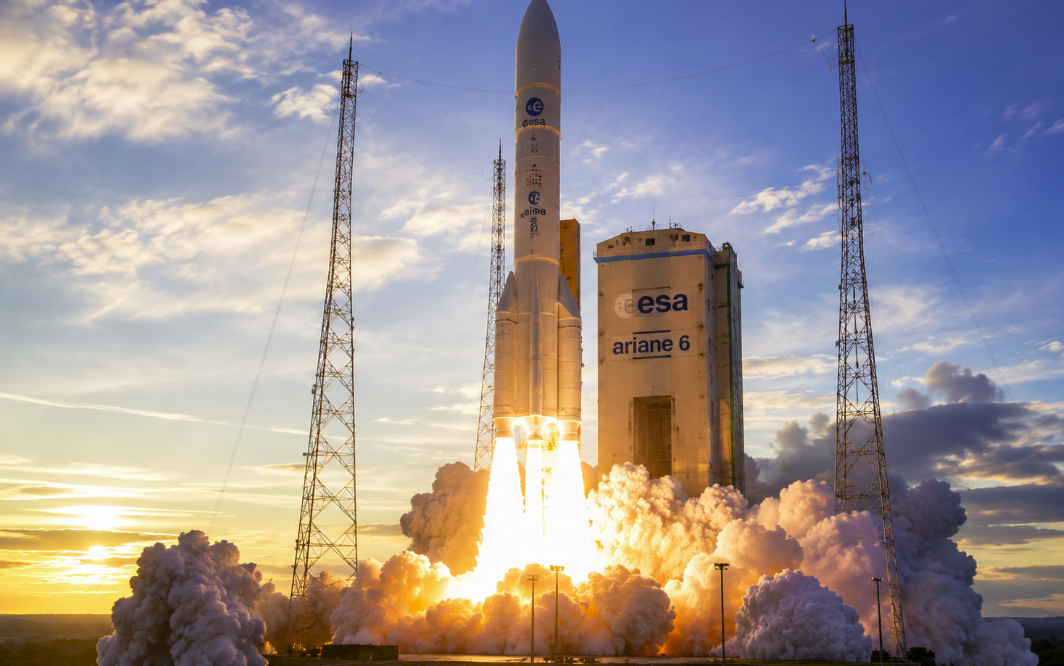
Europe’s Ariane 6 has crossed an important operational threshold. On 27 August, the rocket launched the Meteosat Third Generation Imager 2 satellite, MTG-I2, from Europe’s Spaceport in French Guiana, sending it toward geostationary orbit on the launcher’s first mission to a geostationary transfer orbit and its farthest flight so far. Liftoff occurred at 22:11 CEST, according to the European Space Agency.
The flight matters for two different European infrastructures at once. For Ariane 6, it expands the launcher’s demonstrated mission envelope into the geostationary market that has historically been central to commercial and institutional launch services. For meteorology, MTG-I2 adds another high-capacity observing platform to Europe’s new-generation weather constellation, designed to watch fast-developing storms with much greater frequency and detail than the system it replaces.
Ariane 6 reaches a strategically important orbit
The mission, designated VA270, was the ninth launch of Ariane 6. ESA says the rocket flew in a configuration using two P120C-based solid-propellant boosters and delivered MTG-I2 toward geostationary transfer orbit. Arianespace provided the launch service, while ESA manages the Ariane 6 development programme.
Geostationary transfer orbit is more than another entry in Ariane 6’s mission catalogue. Telecommunications and meteorological spacecraft commonly rely on trajectories that ultimately place them roughly 36,000 kilometres above the equator, where their orbital period matches Earth’s rotation. From there, a satellite can continuously observe or communicate with the same broad region of the planet.
Demonstrating this destination therefore widens the set of missions Ariane 6 can credibly serve. Europe developed the launcher in large part to maintain autonomous access to space after Ariane 5’s retirement, and operational flexibility is essential to that objective. A launcher able to serve low-Earth-orbit constellations, institutional missions and demanding high-altitude payloads is more useful strategically than one confined to a narrow orbital regime.
MTG-I2 is built for weather that changes by the minute
The payload is the second Meteosat Third Generation Imager satellite and the third spacecraft in the first MTG family. Two MTG satellites were already in orbit before this launch. ESA says MTG-I2 completes this initial trio for Eumetsat, strengthening a system intended to provide weather observations across Europe and northern Africa with substantially improved quality, frequency and volume.
The satellite carries two main instruments: the Flexible Combined Imager and the Lightning Imager. Their importance is easiest to understand through time. Conventional forecasts attempt to describe how the atmosphere will evolve over hours and days, but severe thunderstorms, rapidly growing cloud systems and other dangerous conditions can change dramatically over much shorter intervals. Meteorologists therefore also depend on “nowcasting” — tracking and projecting weather on very short timescales.
ESA says the Flexible Combined Imager can scan its full Earth view in 10 minutes and observe Europe and northern Africa as frequently as every 2.5 minutes. That cadence gives forecasters a much denser sequence of observations for following rapidly evolving cloud structures. It is also relevant to aviation, where the position and development of convective weather can have immediate operational consequences.
The Lightning Imager adds a capability that Europe’s earlier meteorological satellites did not provide in the same way: continuous lightning monitoring from geostationary orbit. From approximately 36,000 kilometres above the equator, the instrument can monitor lightning across more than 80% of the Earth disk visible from its position. Lightning activity can reveal the development and intensity of convective storms, making it an important complement to cloud imagery and other atmospheric measurements.
Fifty times more data changes the forecasting problem
One of the most consequential figures in ESA’s mission description is not an orbital altitude or imaging interval. When the Meteosat Third Generation system is fully operational, ESA expects it to generate at least 50 times more data than the previous Meteosat Second Generation satellites.
That is a reminder that the modernization of weather forecasting increasingly depends on computing as much as spacecraft hardware. Higher-resolution imagery, faster refresh cycles and new instrument products give forecasters more information, but only if ground systems can ingest, process and distribute it quickly enough to matter. For severe-weather nowcasting, latency is part of the scientific capability: an excellent observation that reaches decision-makers too late has diminished operational value.
The larger data flow also creates opportunities for automated analysis. Algorithms can continuously compare successive observations, flag rapidly intensifying systems and combine satellite measurements with radar, numerical models and ground observations. The satellite itself is therefore only the visible end of a much larger forecasting infrastructure.
Europe is rebuilding two critical systems at the same time
The timing of VA270 highlights a broader European transition. Ariane 6 is moving from development into a broader operational rhythm while the MTG constellation replaces and extends an older generation of weather satellites. Both programmes concern forms of infrastructure that are easy to overlook when functioning normally but strategically significant when unavailable.
Independent launch capability reduces Europe’s reliance on external providers for access to orbit. Independent meteorological capability gives European institutions a persistent view of weather systems affecting the continent and surrounding regions. The two met on the same launch pad in French Guiana: a European launcher carrying a European weather satellite built for an operational service used every day.
This does not mean either programme has finished proving itself. Ariane 6 must demonstrate reliability and cadence across many launches, while MTG-I2 still has to complete its journey, commissioning and integration into operational meteorological services. A successful launch is the beginning of the satellite’s useful life, not the end of the mission.
Still, VA270 provides a meaningful marker. Ariane 6 has now flown its farthest mission and demonstrated a route toward geostationary operations, while MTG-I2 is on its way to becoming part of a weather-observing system capable of seeing atmospheric change on timescales measured in minutes. The most visible moment was four minutes of launch highlights; the lasting value will be measured in years of orbital access and earlier warnings of dangerous weather.