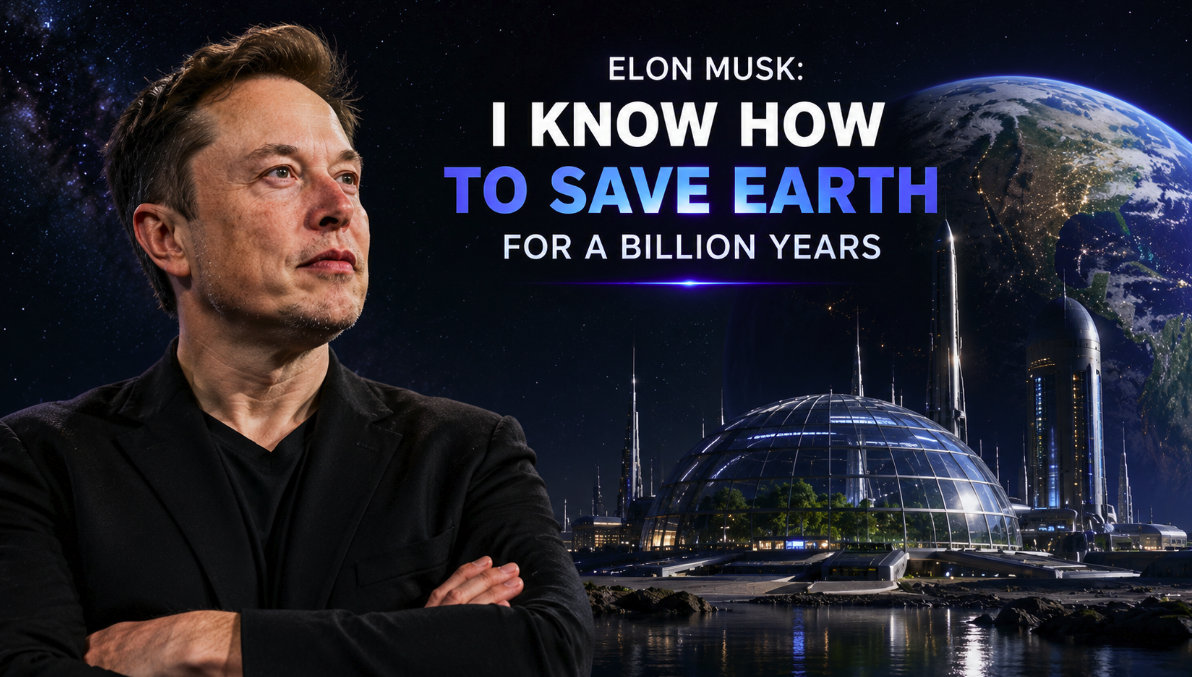
Elon Musk has floated an extraordinary way to keep Earth habitable on geological timescales: use infrastructure on the Moon to launch enormous numbers of intelligent satellites toward the Earth–Sun system, where they could regulate how much solar energy reaches the planet. The idea has been summarized as a plan to “save Earth for a billion years,” but it is important to separate the scale of the vision from what has actually been proposed. This is not an announced SpaceX program, and it is not a deployable answer to present-day climate change. It is a speculative space-engineering architecture whose components would themselves require industrial capabilities far beyond anything humanity possesses today.
Teslarati reported on Musk’s remarks, which emerged from a discussion about using space-based systems to control the amount of sunlight reaching Earth. Musk suggested that “sentient satellites” could be launched from the Moon using mass drivers and positioned around Earth–Sun Lagrange regions. The billion-year timescale reflects a genuinely long-term astronomical problem: the Sun gradually becomes more luminous as it ages, eventually making Earth increasingly hostile to complex life even without human-caused climate change.
The physics problem is real, even if the proposed machine does not exist
The Sun is not a constant-output lamp. Standard stellar-evolution models predict that its luminosity will increase gradually over geological time. Long before the Sun becomes a red giant, higher solar output is expected to alter Earth’s climate and eventually threaten the planet’s long-term habitability. Estimates depend on atmospheric and geological assumptions, but the relevant horizon is measured in hundreds of millions to roughly a billion years rather than human political or technological timescales.
Reducing the sunlight reaching Earth is therefore a physically meaningful thought experiment. Researchers have studied variants of space-based solar-radiation management for decades, including large shades or swarms positioned near the Sun–Earth L1 Lagrange point. A sufficiently large structure or coordinated cloud could, in principle, reduce incoming solar radiation before it reaches the atmosphere.
The difficulty is scale. A system capable of measurably changing Earth’s energy balance would require vast amounts of material, extremely reliable station keeping and long-duration control. If it were intended to operate for geological periods, it would also need continuous maintenance and replacement across civilizations, technologies and environments that cannot realistically be predicted.
Why Musk brings the Moon into the architecture
Musk’s reference to lunar mass drivers connects the climate idea with SpaceX’s increasingly ambitious discussion of lunar industry. A mass driver is an electromagnetic launcher that accelerates payloads without conventional chemical rockets. The Moon is an attractive theoretical location because it has much weaker gravity than Earth and essentially no atmosphere, reducing two major obstacles to launching bulk material into space.
SpaceX has recently discussed building industrial capacity beyond Earth. Musk has said the company intends eventually to land large quantities of cargo on the Moon and build factories there, with robots playing an important role. Those ambitions remain far ahead of current capability, but they explain the logic behind the climate proposal: instead of lifting millions or billions of kilograms of shielding material out of Earth’s deep gravity well, a mature lunar economy could mine, manufacture and launch material locally.
That would require an extraordinary chain of prerequisites. Starship would first have to mature into a highly reliable, rapidly reusable transportation system. Large-scale lunar landings would need to become routine. Power generation, mining, refining, manufacturing, robotics and maintenance would all have to operate on the lunar surface. Only after that industrial base existed would mass-producing and launching a huge satellite swarm become a plausible engineering discussion rather than a conceptual one.
“Sentient satellites” add another layer of speculation
Musk’s wording also points toward autonomous control. A very large distributed swarm could not reasonably depend on humans manually flying each spacecraft. Satellites would need to navigate, coordinate, avoid collisions, manage failures and adjust their configuration as conditions changed. Advanced onboard AI could make such a system more adaptive, although calling those spacecraft “sentient” goes far beyond anything demonstrated by present AI systems.
The concept nevertheless fits SpaceX’s current strategic direction. Musk has increasingly tied the company’s future to artificial intelligence and space-based computing. In an August company update, SpaceX said its next challenge after reusable rockets and satellite internet is making life multiplanetary and understanding the nature of the universe. Recent reporting has also described SpaceX plans for large orbital AI infrastructure powered by solar energy.
That convergence matters because a self-maintaining planetary engineering system would need much more than launch capacity. It would require autonomous manufacturing, robotics, distributed computation and decision-making operating far from Earth. Musk is effectively combining several of his recurring technological themes — reusable rockets, AI, robots, lunar industry and enormous satellite constellations — into a far-future planetary system.
This is not a substitute for cutting emissions
The most important distinction is temporal. Anthropogenic global warming is a present-century problem driven primarily by greenhouse-gas emissions. The Sun’s gradual brightening is an astronomical problem unfolding over hundreds of millions of years. A hypothetical lunar satellite swarm designed for the latter cannot be treated as a reason to postpone emissions reductions, adaptation or existing clean-energy deployment.
Even much smaller forms of solar geoengineering raise difficult scientific and political questions. Reducing incoming sunlight would not directly remove carbon dioxide from the atmosphere or reverse effects such as ocean acidification. Changes to solar radiation could also alter regional precipitation and climate patterns. Any planetary-scale intervention would create governance questions about who controls the system, how targets are chosen and what happens if countries disagree over its effects.
A billion-year autonomous system magnifies those problems to an almost philosophical scale. No present institution can credibly promise stewardship over centuries, let alone geological epochs. The technology would need to remain repairable and controllable through repeated political, cultural and technological transitions.
Starship is the near-term bottleneck behind the far-future vision
The contrast with SpaceX’s present engineering reality is useful. Starship has made substantial progress, including the recovery of an intact upper stage after its July 2026 test flight, but it remains a developing vehicle. SpaceX is working toward much higher launch frequency and full reuse, while NASA is relying on a Starship-derived lunar lander for its Artemis program. Those are difficult objectives on a timescale of years, not geological ages.
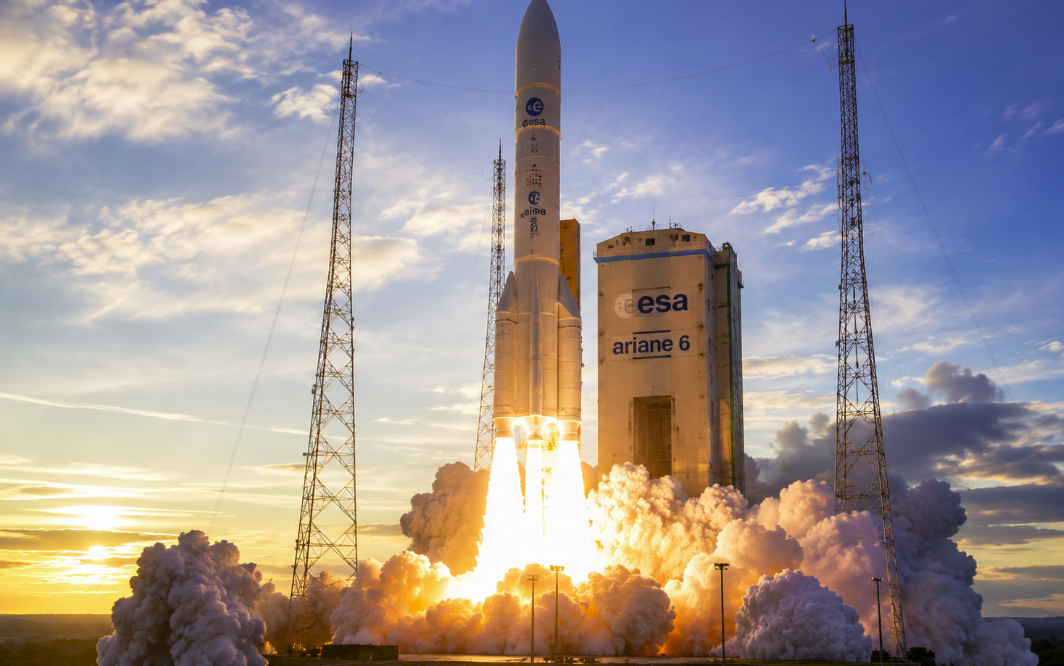
SpaceX is also expanding aggressively. Reuters reported in August that the company plans a $100 billion Starship complex in Louisiana, designed eventually to support extremely high launch rates as well as satellite and AI ambitions. That investment illustrates the industrial scale Musk believes is necessary even for the first stages of his space strategy.
If Starship ultimately achieves aircraft-like reuse and dramatically reduces the cost of placing mass into orbit, some ideas that currently look implausible will become less implausible. But lower launch cost alone does not solve lunar mining, autonomous factories, mass drivers, planetary-scale solar management or billion-year governance. Each is a major technological domain in its own right.
The idea is more useful as a map of Musk’s ambitions
The strongest reason to pay attention to Musk’s proposal is not that humanity is about to build it. It is that the concept reveals how he increasingly connects SpaceX’s individual projects. Starship supplies transportation. Lunar industry supplies material. Robots supply labor. AI supplies autonomy. Large satellite systems provide the architecture. In this worldview, becoming multiplanetary and protecting Earth are not separate objectives but consequences of developing the same space-industrial capabilities.
Whether that architecture can ever work is unknown. The underlying astronomical threat from a gradually brightening Sun is real, while the proposed response remains speculative and unsupported by an announced engineering program. The gap between those two facts is enormous.
For now, humanity’s climate challenge is measured in decades, while Musk’s thought experiment is measured in a billion years. If civilization ever develops the ability to manufacture at planetary scale beyond Earth, controlling a fraction of incoming sunlight may become a legitimate engineering option. The remarkable part of Musk’s proposal is that getting there would require humanity to solve nearly every hard problem in space industry first.