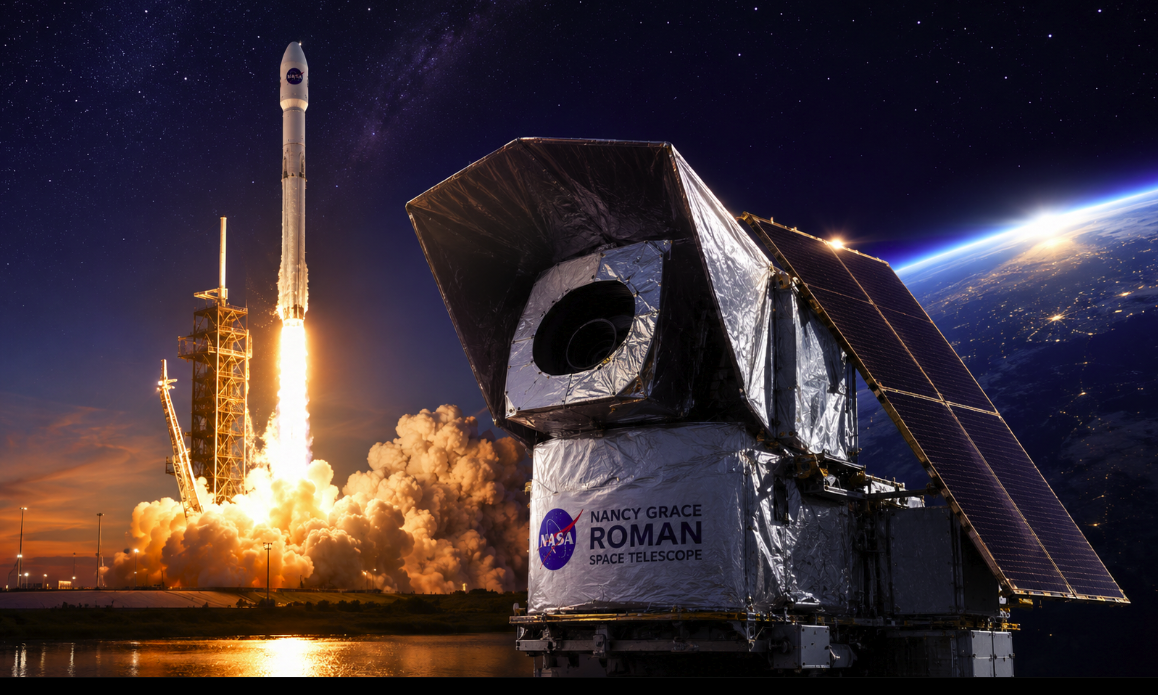
NASA’s Nancy Grace Roman Space Telescope is finally in space. The flagship observatory lifted off at 7:26 a.m. EDT on August 30 aboard a SpaceX Falcon Heavy from Launch Complex 39A at Kennedy Space Center in Florida, beginning a roughly three-month journey to the second Sun-Earth Lagrange point, or L2, about one million miles from Earth.
The launch itself proceeded as planned. According to NASA’s post-launch announcement, controllers at Goddard Space Flight Center began receiving telemetry seven minutes after liftoff, and Roman separated from the Falcon Heavy about 31 minutes into flight. NASA later confirmed deployment of the observatory’s solar panels and lower instrument sun shade. Those milestones put Roman safely into the next phase of the mission, but they do not yet make it an operational telescope.
The coming months will be dominated by deployments, trajectory corrections, instrument activation and calibration. If commissioning proceeds as planned, NASA expects to release Roman’s first images in early 2027. Only then will the mission begin to show why astronomers have spent more than a decade building an observatory that combines the sharpness associated with a flagship space telescope with the ability to survey huge areas of the sky.
Roman is a wide-angle counterpart to Hubble and Webb
Roman’s primary mirror is 2.4 meters across, similar in diameter to Hubble’s, but the defining difference is its field of view. NASA says Roman will cover an area at least 100 times larger than Hubble in a single pointing while maintaining comparable infrared resolution and sensitivity. The observatory is designed to survey the universe as much as 1,000 times faster than Hubble.
That makes Roman less a replacement for Hubble or the James Webb Space Telescope than a complementary survey machine. Webb can study relatively small regions and individual targets with extraordinary infrared sensitivity. Roman is designed to find and characterize enormous populations of objects, providing the statistical context in which unusual galaxies, stars, black holes and planetary systems can be identified for deeper investigation.
NASA offered a useful comparison during launch preparations: Hubble is the detail specialist, Webb the deep-infrared specialist and Roman the wide-area survey observatory. Over its first five years of observations, NASA expects Roman to image more than 50 times as much sky as Hubble has covered over roughly three decades.
Dark energy requires statistics on a cosmic scale
Roman’s wide field is particularly important for one of its central scientific goals: investigating dark energy, the name given to the unknown phenomenon associated with the accelerating expansion of the universe. Understanding that acceleration requires astronomers to measure how galaxies and large-scale cosmic structures are distributed across enormous volumes of space and how that distribution changed over cosmic history.
Roman will use several complementary observational techniques rather than relying on a single measurement. Its surveys are intended to map vast numbers of galaxies and galaxy clusters with enough precision to test competing descriptions of cosmic expansion and the growth of structure. NASA says the mission could measure light from roughly a billion galaxies over its lifetime.
Roman will also study dark matter, the invisible material inferred from its gravitational effects on visible matter. By examining how foreground mass distorts the apparent shapes and positions of more distant galaxies through gravitational lensing, astronomers can reconstruct aspects of the otherwise unseen matter distribution. Large, consistently observed samples are essential for reducing statistical uncertainty, making Roman’s combination of image quality and survey area particularly valuable.
Roman will conduct an enormous experiment in planetary demographics
The observatory is also built to investigate planets beyond the solar system. Rather than concentrating primarily on planets that transit their host stars, Roman will use gravitational microlensing, watching the brightness of distant stars toward the crowded center of the Milky Way for temporary changes caused when intervening planetary systems bend and magnify their light.
During launch coverage, NASA said Roman’s surveys are expected to uncover roughly 100,000 new exoplanets. The observatory will monitor hundreds of millions of stars, giving astronomers a statistical view of planetary systems that is difficult to obtain using techniques biased toward planets orbiting close to their stars.
The result could be less about discovering one spectacular new world and more about answering a broader question: what does a typical planetary system in the Milky Way actually look like? By detecting planets across different orbital distances and masses, Roman can help determine how common different architectures are and how our own solar system fits into the wider galactic population.
A coronagraph will test technology for the search for another Earth
Roman’s second major instrument, the Coronagraph Instrument, has a different role. Built by NASA’s Jet Propulsion Laboratory, it is a technology demonstration designed to suppress the overwhelming light of a star so that much fainter nearby planets and disks can be observed directly.
JPL says the instrument will demonstrate advanced hardware for studying planets around other stars. Roman is expected to image Jupiter-like planets rather than Earth twins, but the technologies being demonstrated could inform future missions capable of pursuing far more demanding targets.
NASA specifically links that development path to the proposed Habitable Worlds Observatory, a future flagship concept intended to directly image potentially Earth-like planets around Sun-like stars. Roman’s coronagraph therefore occupies an unusual position: its scientific observations matter, but its engineering performance could also influence how the next generation of planet-finding telescopes is designed.
The data stream may be as transformative as the telescope
Roman is expected to send approximately 1.4 terabytes of data to Earth every day, which NASA describes as the highest data rate yet for one of its astrophysics missions. The observatory’s technical documentation lists a downlink capability of roughly 250 to 500 megabits per second and a daily data volume of about 11 terabits.
That changes the practical nature of the mission. Roman will not simply provide individual images for astronomers to inspect manually. Its surveys will generate an enormous public archive containing repeated observations of vast numbers of objects. NASA expects machine learning, artificial intelligence and citizen-science projects to help identify significant events and unusual targets within the stream.
In this sense, Roman represents a broader shift in astronomy from observing scarce individual targets toward mining immense standardized datasets. Discoveries can emerge years after an observation was made because researchers ask a question the original survey designers did not anticipate. The archive itself becomes a scientific instrument.
Launch was the beginning, not the finish line
Roman is now traveling toward L2, the same broad gravitational region used by the James Webb Space Telescope. During its early journey, communications transition from NASA’s Near Space Network to the Deep Space Network, with stations in Australia, Spain and California supporting the spacecraft. ESA and JAXA ground infrastructure will also contribute to mission communications.
The next steps include deployment of Roman’s high-gain antenna and aperture cover, mid-course trajectory corrections and activation of the Coronagraph Instrument. The 300-megapixel Wide Field Instrument, which uses 18 4K detectors, is scheduled to power on a few weeks into the journey. Engineers will then spend the rest of the commissioning period calibrating and testing the observatory before science operations can begin.
Those milestones matter because Roman’s scientific promise depends on precision. Measuring tiny distortions in galaxies, finding short-lived microlensing signals and conducting consistent wide-field surveys all require the observatory to perform as an exceptionally stable measurement system, not merely as a camera that successfully reached space.
The August 30 launch has removed one of the mission’s largest risks and started the clock on that commissioning campaign. If Roman reaches L2 and performs as designed, astronomers will gain something they have never previously had at this scale: Hubble-like clarity combined with a panoramic view of the universe. The first images expected in early 2027 will be the public milestone, but the deeper test will come afterward, when Roman begins turning that unprecedented field of view into statistics about the dark universe and the planets scattered throughout our galaxy.