Astronomers have extracted the collective radio glow of neutral hydrogen from billions of years in the past using South Africa’s MeerKAT telescope, strengthening the case for a radically different way to map the Universe. Rather than identifying galaxies one by one, the method measures the combined 21-centimeter emission of hydrogen across large volumes of space, allowing researchers to reconstruct matter on cosmological scales even when the individual galaxies producing the signal cannot be resolved.
The result, reported in The Astrophysical Journal Letters, comes from roughly 96 hours of MeerKAT observations and targets two epochs at redshifts of about 0.32 and 0.44. That corresponds to radiation that has travelled for roughly four to five billion years before reaching Earth. The important point is not simply that distant hydrogen was detected: the team recovered its statistical clustering signal directly from radio observations, demonstrating that hydrogen intensity mapping can operate as an independent cosmological measurement rather than merely as a signal revealed through comparison with an optical galaxy catalogue.
Why the 21-centimeter line can become a cosmic map
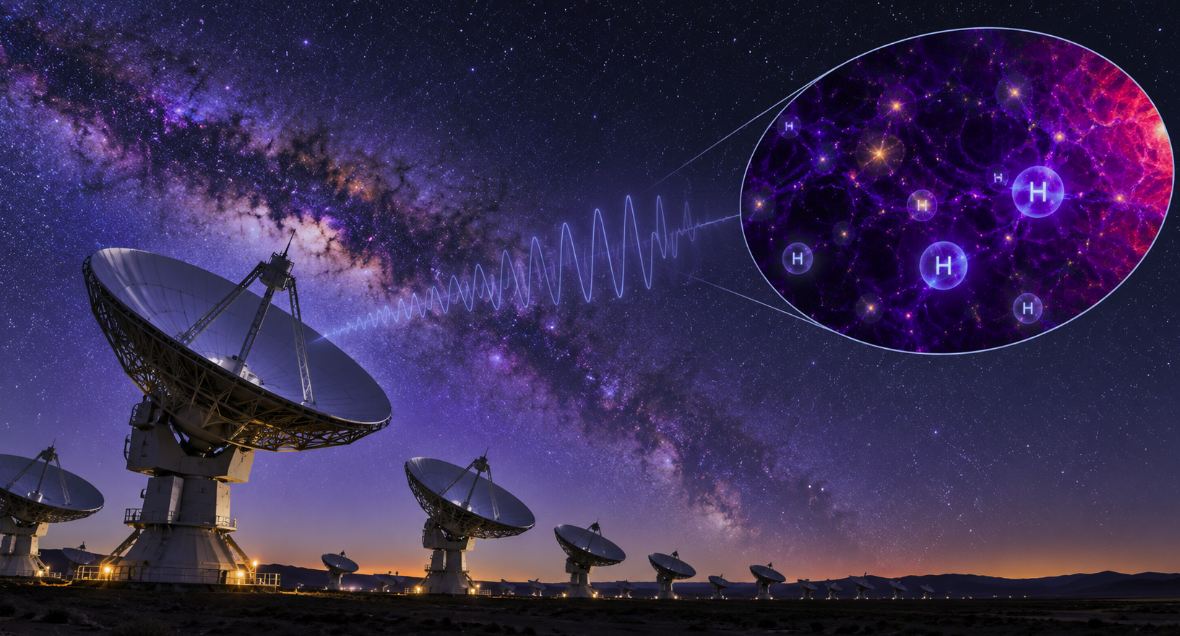
Neutral atomic hydrogen emits radiation at a characteristic rest wavelength of about 21 centimeters, or a frequency near 1.42 GHz. Cosmic expansion stretches that radiation to longer wavelengths, so its observed frequency carries information about the distance and epoch from which it came. Measure the signal across both the sky and radio frequency, and in principle astronomers can build a three-dimensional map: two dimensions describe position on the sky, while frequency supplies the radial, redshift dimension.
The attraction of intensity mapping is scale. Conventional galaxy surveys generally need to detect and characterize enormous numbers of individual objects. Intensity mapping deliberately gives up that object-by-object view and measures the unresolved emission from many galaxies together. The result is a lower-resolution map, but one that can potentially cover huge cosmic volumes efficiently. That makes it particularly interesting for tracing the cosmic web, studying how gas occupies dark-matter structures and eventually measuring large-scale features linked to the expansion history of the Universe.
The underlying signal, however, is exceptionally difficult to recover. Galactic foreground emission, bright extragalactic radio sources, human-made radio-frequency interference and instrumental effects can overwhelm the cosmological hydrogen contribution. The challenge is therefore less like photographing a faint object and more like extracting a weak statistical pattern buried beneath much stronger contamination.
The significance is in separating the signal
The MeerKAT analysis demonstrates that the hydrogen power spectrum can be recovered on megaparsec scales at two redshifts using interferometric radio data. The measurements probe structures spanning millions of light-years. According to the University of Manchester, the observations were not originally designed specifically for this intensity-mapping experiment, which makes the successful extraction especially relevant for the reuse of existing radio-astronomy data.
That distinction matters because hydrogen intensity mapping has already produced important results through cross-correlation, where radio maps are compared with independent tracers whose positions are known from other surveys. For example, the CHIME collaboration has detected cosmological 21-centimeter emission by correlating radio measurements with galaxies, quasars and the Lyman-alpha forest. Cross-correlation is powerful because the independent catalogue helps isolate a common cosmological signal, but it also means the radio data are not doing all the work by themselves.
An auto-correlation measurement instead asks whether structure can be recovered from the radio map itself. This is a demanding test of foreground removal, calibration and control of instrumental systematics. It is also the form of measurement needed if future hydrogen surveys are to exploit radio observations as a stand-alone probe across enormous volumes of the Universe.
A path toward much larger surveys
MeerKAT consists of 64 radio dishes in South Africa and is an important precursor facility for the Square Kilometre Array Observatory. The new result therefore serves as more than an isolated detection: it is a practical demonstration of analysis techniques that could become increasingly valuable as radio arrays produce larger and deeper data sets.
The immediate scientific payoff is the ability to investigate how neutral hydrogen traces the underlying matter distribution and how that relationship changes with cosmic time. On still larger scales, 21-centimeter surveys are intended to probe cosmological structure itself. Features such as baryon acoustic oscillations provide a characteristic distance scale whose apparent size at different redshifts can be used to study the expansion history of the Universe and, indirectly, the behavior of dark energy.
There is an important caveat. A successful detection over a limited field does not automatically mean precision hydrogen cosmology is solved. Future surveys must control foreground leakage, radio interference, beam effects, calibration errors and other systematics across far larger areas and observing campaigns. Statistical uncertainties will shrink as more data arrive, making subtle instrumental biases increasingly important rather than less so.
The next step is therefore scale rather than spectacle. The team plans broader and longer MeerKAT observations to improve the hydrogen maps, while other experiments are pursuing complementary versions of the same idea. CHIME has demonstrated 21-centimeter measurements at higher redshifts, and theoretical work continues to refine how the hydrogen signal connects to dark-matter halos and cosmological parameters.
If those methods mature, radio telescopes will not need to turn every distant galaxy into a catalogued point to reveal the architecture of the cosmos. They can instead measure the aggregate whisper of hydrogen across space and frequency. MeerKAT’s result shows that this once notoriously difficult signal can be recovered directly from interferometric observations, moving hydrogen intensity mapping another step from promising concept toward a survey technique capable of charting the evolving cosmic web.