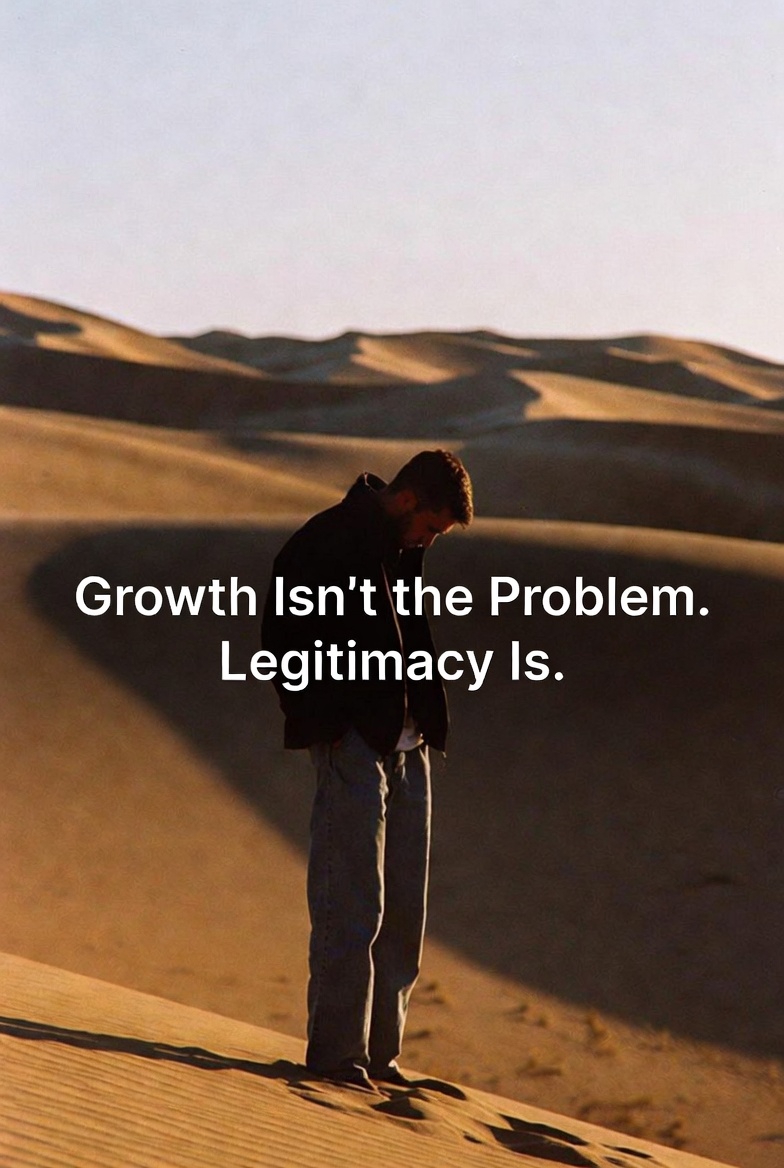
For years, we’ve been told the same story:
growth fixes everything.
If the economy grows, inequality will rebalance.
If markets expand, legitimacy will follow.
If innovation accelerates, society will adapt.
But history keeps disagreeing.
The real tension isn’t between growth and decline.
It’s between growth and legitimacy.
Growth is an incentive.
Legitimacy is a constraint.
A system can grow very fast while quietly losing the consent that allows it to exist.
And when legitimacy erodes, growth doesn’t stop immediately — it accelerates in the wrong direction.
This is where many people get confused.
They assume the problem is distribution.
But distribution is only the visible layer.
The deeper issue is trust.
When people believe a system is fair, they tolerate asymmetries.
When they don’t, even small imbalances feel unbearable.
Growth compounds automatically.
Legitimacy doesn’t.
Legitimacy must be maintained, explained, justified — continuously.
And once it’s gone, it cannot be “optimized” back with better metrics or nicer narratives.
This is why some institutions keep growing while becoming increasingly fragile.
They replace legitimacy with scale.
They replace consent with compliance.
They replace trust with power.
That works — until it doesn’t.
At that point, the system looks for substitutes:
-
regulation instead of trust
-
enforcement instead of consent
-
complexity instead of clarity
But those are stabilizers, not foundations.
Growth can motivate a system.
Distribution can sustain it.
But legitimacy is what keeps it alive.
And legitimacy, once lost, is the hardest thing to rebuild.
The question isn’t whether growth will continue.
It almost always does.
The real question is:
what replaces legitimacy when trust is gone?