LMBDA Research & Insights | November 9, 2026
Five astronauts whose careers span different chapters of human spaceflight appeared together onstage at the Artemis Celebration Gala at NASA's Kennedy Space Center Visitor Complex on November 6, 2026. The image, shared in a NASA feature titled Astronauts Across Generations Share the Stage, captures Randy Bresnik, Luca Parmitano, Russell “Rusty” Schweickart, Frank Rubio and Bob Hines in a single frame.
The gathering, organised by Purpose Entertainment in Merritt Island, Florida, celebrated the completion of NASA's Artemis II mission and looked ahead to the campaign's ambition of returning humans to the lunar surface. Its strongest message was not a new technical announcement but a reminder that deep-space exploration is built on knowledge accumulated across generations.
Five astronauts, several eras of exploration
The NASA image identifies the astronauts from left to right as Randy Bresnik, Luca Parmitano, Rusty Schweickart, Frank Rubio and Bob Hines. They bring different experiences to the same stage: Apollo-era lunar-programme history, space shuttle operations, long-duration life aboard the International Space Station and contemporary astronaut training and missions.
Schweickart flew on Apollo 9 in 1969, a critical Earth-orbit mission that tested the lunar module and spacesuit operations ahead of the first lunar landing. Bresnik later flew on the space shuttle and commanded an International Space Station expedition. Parmitano, an Italian astronaut with the European Space Agency, flew two long-duration missions and commanded the station. Rubio completed an exceptionally long mission aboard the ISS, while Hines served as a pilot on a SpaceX Crew Dragon mission to the station.
Those biographies explain why the group photograph resonates. It brings together people associated with the engineering tests that made Apollo possible and astronauts who helped sustain the continuous human presence in low Earth orbit that informs today's deep-space planning.
What happened at the Artemis Celebration Gala?
According to NASA's account, Purpose Entertainment hosted the gala on November 6 at the Kennedy Space Center Visitor Complex. The event took place ahead of NASA's MAX POWER event and recognised explorers, innovators and other contributors to the next era of human spaceflight.
NASA describes the evening as a celebration of Artemis II's successful completion and as an occasion to look toward future lunar surface missions. The gala was also presented as one of the signature events closing the United States' 250th-anniversary celebrations.
The NASA image article provides the event's location, date, participants and purpose. It does not, in the supplied account, document new mission assignments, a revised lunar-landing schedule or technical findings from Artemis II. Those developments should not be inferred from a commemorative event.
Why Artemis II matters in the longer story
Artemis is NASA's programme for renewed human exploration of the Moon, intended to build capabilities for sustained lunar operations and, over the longer term, missions to Mars. Artemis II was the programme's first crewed flight around the Moon, following the uncrewed Artemis I test mission.
For an audience at Kennedy Space Center, the connection to Apollo is especially tangible. Apollo-era missions tested spacecraft, navigation, life-support systems and human operations in conditions that were unprecedented at the time. Modern missions build on those foundations while introducing new vehicles, partnerships and operational requirements.
Celebrating Artemis II does not mean that the hardest tasks of a lunar landing have been completed. Surface access, spacesuit readiness, lander development, mission integration and operational safety are separate challenges that require their own demonstrations and approvals.
From Apollo 9 to the International Space Station
Rusty Schweickart's presence gives the photograph a direct connection to Apollo. As the lunar module pilot of Apollo 9, he helped validate spacecraft systems and performed an extravehicular activity during the mission. Apollo 9 never went to the Moon; its importance lay in proving crucial equipment in Earth orbit before later crews attempted a landing.
The other astronauts represent an era in which the International Space Station became a laboratory for long-duration human spaceflight. Station missions have generated operational experience in crew health, equipment maintenance, robotics, communications, scientific research and multinational coordination.
That experience is relevant to Artemis, but the ISS and lunar missions are not identical. Crews travelling beyond low Earth orbit must contend with different communication delays, radiation environments, return options and logistical constraints. Knowledge transfers across programmes only when engineers and mission planners adapt it to the new environment.
An international dimension to lunar exploration
The presence of ESA astronaut Luca Parmitano highlights another defining feature of modern human spaceflight: international cooperation. Artemis involves NASA and partners across government, industry and international space agencies. The programme's long-term success will depend not only on launch vehicles and spacecraft but also on the ability of institutions to integrate technical standards, operational procedures and scientific priorities.
Parmitano's participation in the gala is not evidence of a new Artemis flight assignment. It is better understood as part of the event's broader recognition of astronauts and organisations contributing to the culture and expertise of human exploration.
Why ceremonies like this matter—and what they do not tell us
Spaceflight coverage understandably concentrates on launch dates, propulsion systems, budgets and mission outcomes. Public events serve a different function. They connect past achievements to future goals, give audiences a human view of exploration and acknowledge the many careers that make a mission possible.
They can also obscure the distinction between celebration and programme status if interpreted too broadly. A successful crewed lunar flight is a significant milestone, but it does not by itself confirm the readiness of every system needed for a future surface landing. The most reliable way to follow Artemis progress remains NASA's official mission updates, technical briefings and schedule announcements.
Frequently asked questions
Who appeared in NASA's November 6, 2026 astronaut photograph?
NASA identifies Randy Bresnik, Luca Parmitano, Russell “Rusty” Schweickart, Frank Rubio and Bob Hines, from left to right.
Where was the Artemis Celebration Gala held?
At NASA's Kennedy Space Center Visitor Complex in Merritt Island, Florida, on November 6, 2026. The event was hosted by Purpose Entertainment.
What was the gala celebrating?
NASA says it honoured the successful completion of Artemis II, recognised people advancing human spaceflight and looked ahead to future lunar surface exploration.
Did the gala announce the next Moon landing date?
Not in the supplied NASA image article. It was described as a commemorative event, not a technical programme-status announcement.
Why is Rusty Schweickart historically important?
He flew on Apollo 9, a 1969 mission that tested the lunar module and important procedures for subsequent Apollo lunar missions.
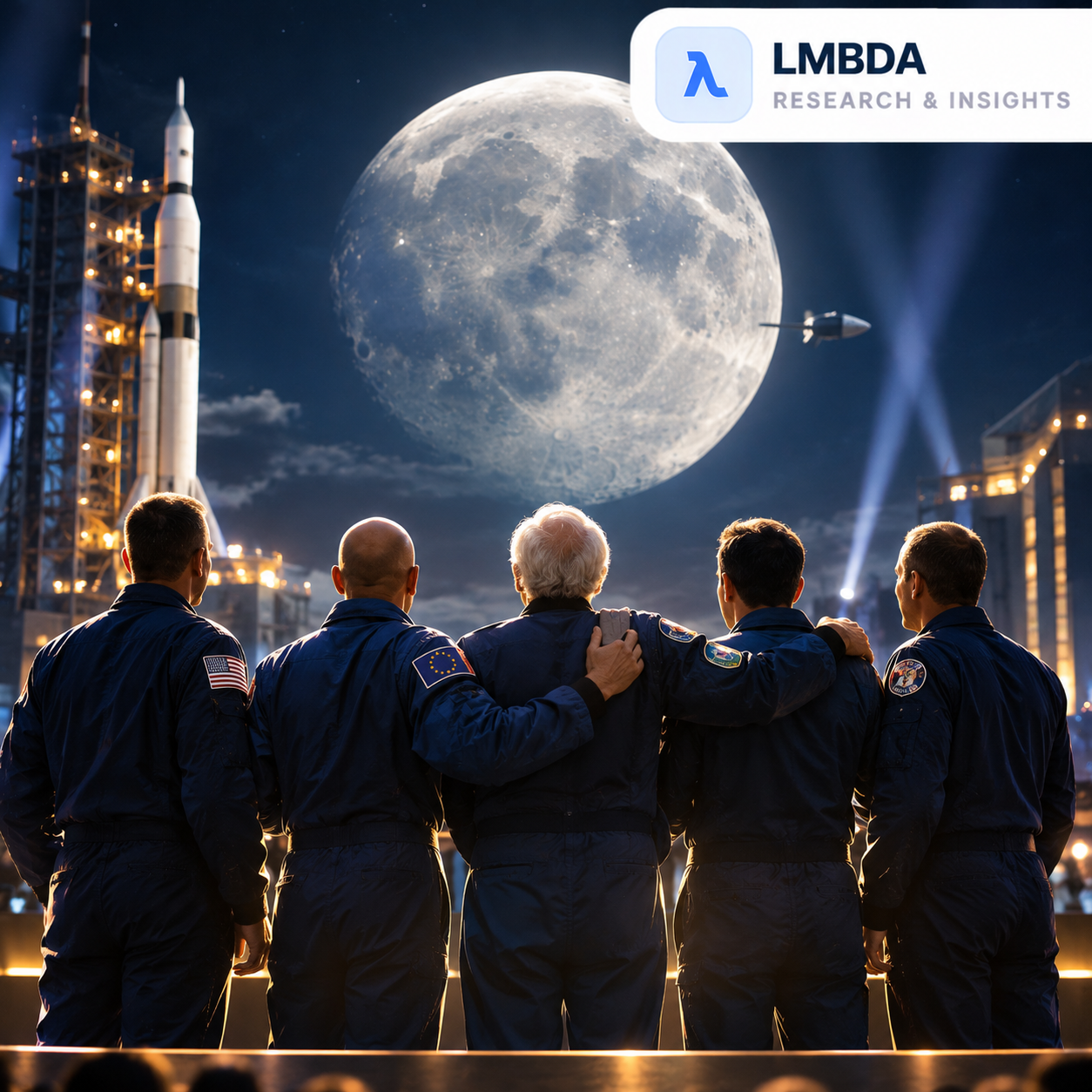
Is the LMBDA cover a photograph from the gala?
No. The editorial cover is a conceptual illustration. The authentic event photograph is credited by NASA to Purpose Entertainment/Shanna Lockwood and can be viewed at the source.
A photograph of continuity
The November 6 image is a compact reminder that the space programme is not a series of disconnected eras. Apollo's engineering lessons, the shuttle's operational experience, the ISS's long-duration research and Artemis's lunar ambitions form a continuing body of knowledge. Five astronauts on one stage cannot capture all the people involved, but the photograph makes that continuity visible.
Source and image credit
NASA — Astronauts Across Generations Share the Stage. Event photograph credited by NASA to Purpose Entertainment/Shanna Lockwood. The NASA article text supplied for this report was used for event details; the source page could not be independently retrieved during preparation. Biographical context is historical background, not a claim that NASA's event article itself contains those biographies.