When Space Physics Comes Down to Earth
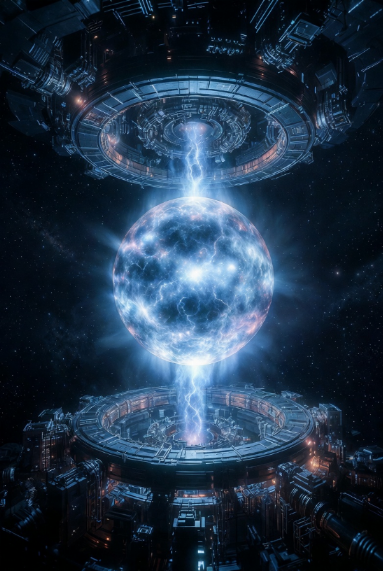
Stars are not just distant objects lighting the night sky. They are natural fusion reactors, powered by the same physical processes scientists are now attempting to recreate on Earth.
In recent years, fusion experiments have reached temperatures and plasma conditions once thought unattainable outside stellar cores. While headlines often simplify this as creating a “mini sun,” the reality is both more complex—and more interesting.
What’s happening is not spectacle. It’s space physics applied in laboratories.
Fusion: The Engine of the Universe
At the heart of every star lies nuclear fusion. Hydrogen nuclei collide under immense pressure and temperature, forming heavier elements and releasing extraordinary amounts of energy.
This process:
-
Powers stars for billions of years
-
Shapes galaxies
-
Determines the lifecycle of cosmic structures
Reproducing fusion on Earth means recreating the same fundamental conditions that exist in stellar environments—without gravity doing the heavy lifting.
Why Fusion Belongs in Space Science
Fusion research is often framed purely as an energy story. But at its core, it is astrophysics in action.
Fusion experiments help scientists:
-
Test models of stellar behavior
-
Study plasma dynamics found in stars and nebulae
-
Improve simulations of solar activity and cosmic radiation
In this sense, fusion labs are like controlled star simulators, offering insights impossible to gather by observation alone.
The Role of Plasma Physics
Fusion relies on plasma—the fourth state of matter—where atoms are stripped of electrons and behave collectively under electromagnetic forces.
Plasma dominates the visible universe:
-
Stars
-
Solar winds
-
Accretion disks
-
Interstellar space
By learning to control plasma on Earth, scientists refine our understanding of how the universe itself operates at scale.
Magnetic Confinement: Holding a Star Without Gravity
Stars rely on gravity to compress fusion fuel. On Earth, scientists replace gravity with magnetic fields.
Devices like tokamaks and stellarators use powerful superconducting magnets to:
-
Confine plasma
-
Stabilize extreme temperatures
-
Prevent material contact with reactor walls
This technology mirrors the invisible forces shaping cosmic structures, translated into engineering.
Why This Matters Beyond Energy
Fusion is not just about power generation. Mastering fusion means mastering:
-
Extreme materials science
-
Precision magnetic control
-
Advanced simulation and modeling
These capabilities directly impact:
-
Space propulsion concepts
-
Radiation shielding
-
Long-duration space missions
-
Off-world infrastructure design
Fusion research quietly supports humanity’s long-term presence beyond Earth.
Space Exploration Needs Star Power
Future space missions—especially deep-space or interplanetary travel—will demand energy sources far beyond chemical propulsion or solar panels.
Fusion offers theoretical pathways to:
-
High-efficiency propulsion
-
Long-term power for space habitats
-
Reduced dependency on Earth resupply
In that sense, fusion is as much about where we’re going as how we power our cities.
Managing Expectations
Despite progress, fusion is not a solved problem. Sustained, commercially viable fusion remains a challenge.
But the trend is clear:
-
Experiments last longer
-
Temperatures rise
-
Control improves
Science advances through accumulation, not miracles.
The Bigger Picture
Recreating stellar processes on Earth represents something deeper than energy innovation. It reflects humanity’s ability to understand and replicate the laws of the universe, rather than merely observe them.
Fusion research sits at the boundary between Earth and space, engineering and astrophysics, ambition and patience.
Final Thought
When scientists attempt to build a star on Earth, they are not playing with fire. They are learning the language of the cosmos—one equation, one experiment at a time.
As always with breakthroughs that sound unbelievable:
Verify the sources. Verify the data.
Then watch closely—because space science is getting closer than ever.