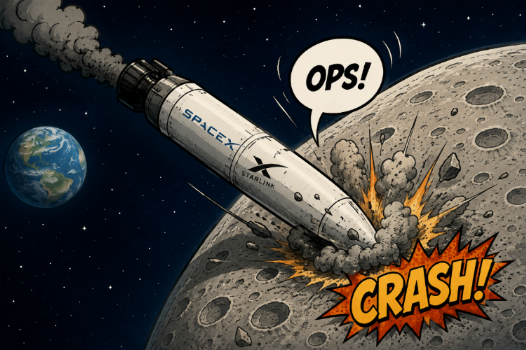
If someone had told you ten years ago that a discarded rocket stage would accidentally crash into the Moon, it would have sounded like the plot of a science fiction movie.
Today, it's simply another reminder of how quickly space exploration is changing.
This week, the upper stage of a SpaceX Falcon 9 rocket completed a journey nobody originally planned. After spending more than a year drifting through cislunar space following a mission that launched two commercial lunar landers, the spent stage eventually collided with the Moon near Einstein Crater. Scientists expected the impact and later detected evidence consistent with the collision, even though no direct video of the moment has yet been confirmed.
At first glance, it's an unusual story. A rocket crashes into the Moon. End of the news cycle.
But I think the event is interesting for a different reason.
It reminds us that the Moon is no longer a distant place visited once every few decades. It is slowly becoming part of a much larger transportation network.
Government agencies, private companies and international partnerships are all planning missions beyond Earth orbit. NASA's Artemis program aims to return astronauts to the lunar surface, commercial companies are delivering scientific payloads, and new lunar landers are launching almost every year. The amount of hardware travelling between Earth and the Moon is increasing, and with it comes a new challenge that previous generations barely had to consider.
The Falcon 9 stage wasn't intentionally sent into the Moon. It had already completed its job after helping deliver Firefly Aerospace's Blue Ghost lander and ispace's Resilience mission toward lunar space in early 2025. Once its mission ended, gravitational interactions gradually altered its orbit until an impact became inevitable.
Events like this are unlikely to pose any danger to people on Earth, and the Moon has been hit by natural objects for billions of years. In that sense, one more impact isn't a planetary emergency.
What changes is the source.
For the first time, we're beginning to see the side effects of sustained human activity extending beyond Earth orbit.
That raises interesting questions.
How should abandoned hardware be managed once missions are complete?
Should future lunar missions include more robust disposal plans?
Will international guidelines eventually be needed for traffic around the Moon, much like today's discussions about orbital debris around Earth?
These questions may sound premature, but history suggests it's easier to establish good practices before traffic becomes crowded rather than after.
Perhaps that's the real story behind this impact.
It isn't about a rocket hitting the Moon.
It's about the fact that human activity in lunar space is becoming common enough that these events will probably happen again.
The Moon is no longer just a destination.
Little by little, it's becoming part of humanity's everyday space infrastructure.
And that's a remarkable change to witness.