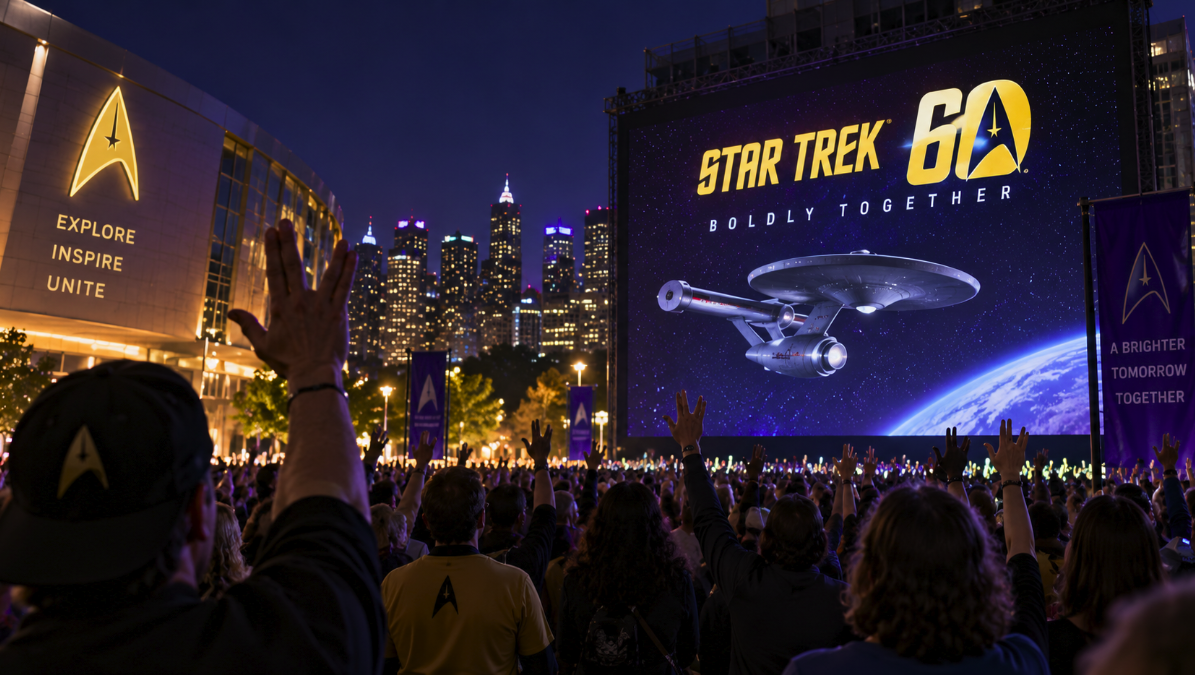
Sixty years after Star Trek first reached American television screens, its anniversary is being staged less like a retrospective for an old entertainment property and more like a demonstration of a still-active global culture. The franchise reaches its 60th birthday on September 8, 2026, marking six decades since the original series debuted on NBC with “The Man Trap” in 1966. Paramount’s anniversary program stretches from movie theaters and television specials to museums, public gatherings and even the International Space Station.
The scale of the celebration says something important about what Star Trek has become. Paramount says the franchise now spans 11 television series, 14 films and more than 900 episodes. Yet the most revealing anniversary events are not simply opportunities to replay that archive. They turn familiar symbols — the Vulcan salute, Starfleet insignia and the Enterprise itself — into shared rituals designed to connect generations of viewers.
A Vulcan salute becomes a global participation event
One of the clearest examples arrives in London on September 8. Fans are being invited to the Science Museum for an official Guinness World Records attempt for the most people performing the Vulcan salute simultaneously. The event is part of a broader global digital salute, transforming a gesture introduced through Leonard Nimoy’s Spock into an unusually literal measure of cultural reach.
According to Paramount’s anniversary overview, London will also host themed activity around King’s Cross St Pancras and South Kensington Underground stations, while celebrations elsewhere include events in Germany and Los Angeles. In Hollywood, the plaque associated with creator Gene Roddenberry’s star on Hollywood Boulevard is also being restored as part of the anniversary.
The Vulcan salute is particularly suited to this kind of event because it escaped the boundaries of the television series long ago. It can communicate an association with Star Trek without costumes, dialogue or even a shared language. A Guinness record attempt may be playful, but it also illustrates how entertainment franchises endure when audiences can actively perform their symbols rather than only consume their stories.
The anniversary is moving between screens instead of staying on one
Theatrical exhibition is another major part of the 60th anniversary. Restored versions of the first four Star Trek feature films are being shown in more than 750 U.S. theaters from September 4 through September 8, with screenings paired with episodes from Star Trek: The Original Series. The approach connects the franchise’s television origins with the movies that extended the original crew’s story into a second era.
Television is participating too. Anniversary programming includes Star Trek-themed editions of The Price Is Right and Let’s Make a Deal, while Entertainment Tonight is drawing on archival material. In Los Angeles, Paramount has announced an outdoor event at the Autry Museum featuring “The Man Trap” alongside an advance screening connected to Star Trek: Strange New Worlds. The pairing is deliberate: the episode that introduced the franchise to television audiences in 1966 is being placed next to a current production carrying the fictional universe forward.
That mixture of restoration and new material avoids one of the traps of a major media anniversary. A 60-year celebration could easily become an exercise in nostalgia aimed primarily at viewers who remember earlier eras. Instead, the programming repeatedly places old and new Star Trek beside each other, presenting continuity itself as the attraction.
Star Trek is also returning to actual space
The anniversary’s most fitting crossover between fiction and reality is scheduled to happen aboard the International Space Station. European Space Agency astronaut Sophie Adenot is expected to participate in commemorative activity while wearing a Captain’s Delta badge associated with Star Trek: Strange New Worlds. It is a small symbolic gesture, but one loaded with historical irony: a television program once constrained by 1960s production technology is now being commemorated by a human living in orbit.
The relationship between Star Trek and real-world spaceflight has always been more complicated than a simple claim that fiction predicted technology. The franchise imagined faster-than-light travel, transporters and many other technologies that remain fictional. Its more durable influence has been cultural. It made scientific exploration, engineering and international cooperation central to an optimistic picture of the future at a time when television science fiction could easily have emphasized invasion, catastrophe or technological fear.
That is why an anniversary connection to the ISS works even without pretending that today’s space program resembles Starfleet. The station itself is a multinational scientific project in low Earth orbit. Its existence reflects a much narrower and more difficult reality than the fictional Federation, but the visual connection between astronaut and insignia captures the feedback loop between imagined exploration and the people who eventually pursue exploration professionally.
Why 60 years is different from simple longevity
Many entertainment properties survive for decades through reruns, remakes or licensing. Star Trek has done all of those things, but its longevity also depends on repeated reinvention. The original crew gave way to The Next Generation, which in turn helped establish a period in which multiple series could explore different corners of the same fictional setting. Later productions changed tone, chronology, visual style and distribution model while retaining enough common vocabulary to remain recognizable.
That flexibility helps explain why Paramount’s anniversary messaging emphasizes values such as exploration, optimism and unity rather than a single cast or series. Those ideas provide a bridge across productions that can otherwise look very different from one another. They also give fans a way to identify with Star Trek that does not depend on having watched every episode.
The anniversary arrives at a moment when major franchises face intense pressure to remain permanently visible through streaming, theatrical releases, merchandise and fan events. Star Trek is no exception to that commercial reality. But the 60th birthday highlights a harder-to-manufacture asset: generations of viewers have already attached personal and cultural meaning to its imagery. A studio can organize a screening or record attempt; it cannot simply manufacture six decades of accumulated audience memory on demand.
On September 8, the most telling image may therefore not be a restored movie frame or a piece of anniversary merchandise. It may be thousands of hands forming the same four-finger gesture in London and elsewhere, repeating a symbol first associated with an alien character on a television soundstage six decades earlier. For a franchise built around the idea that humanity might build a future through curiosity and cooperation, becoming a ritual shared by people in the present is a remarkably appropriate way to turn 60.