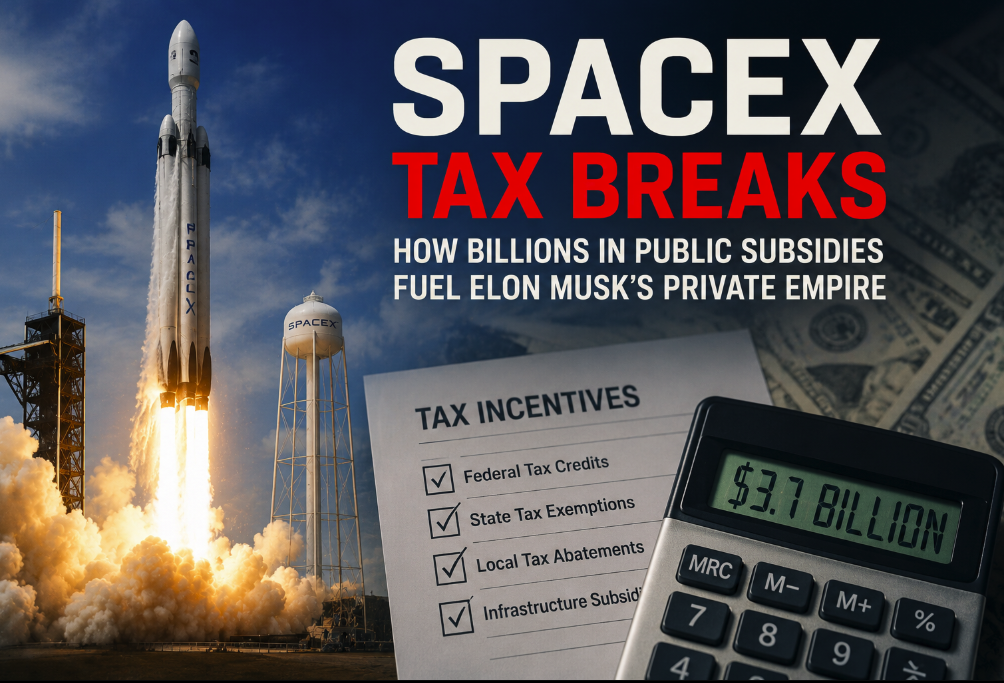
Louisiana has landed what state officials describe as the largest capital investment in its history: SpaceX plans to spend $100 billion building a vast Starship complex on the Gulf Coast. But the deal is also an unusually large experiment in economic development policy. To attract a project that promises thousands of jobs and potentially thousands of rocket launches a year, Louisiana has rewritten parts of its tax code, created aerospace incentives and agreed to a local tax structure that substitutes negotiated payments for ordinary property taxes.
The scale and mechanics of those incentives were detailed in a Louisiana Illuminator investigation published September 1. The important question is not simply whether SpaceX is receiving a tax break. It is whether the economic value Louisiana receives from Starbase Louisiana ultimately exceeds the public revenue and policy flexibility the state is giving up to secure it.
That calculation is unusually difficult because the headline numbers sit on different sides of the ledger. SpaceX says it intends to invest $100 billion. Louisiana Economic Development expects 3,000 direct jobs over 10 years with an average annual salary of $92,600, plus about 8,100 indirect jobs. Yet the eventual value of tax rebates and exemptions depends on qualifying spending, payroll and the duration of the project, meaning the full public cost cannot be reduced to one reliable number today.
A spaceport designed like a self-contained city
The planned site near Pecan Island in Vermilion Parish covers roughly 125,000 acres of coastal Louisiana. According to Louisiana Economic Development, full buildout is expected to include five launch complexes with two pads each, propellant farms, fuel production and employee housing. Other announced plans include power generation, deep-water shipping infrastructure and potentially an airport.
Construction is expected to begin by the end of 2027, with the first Starship launch targeted as soon as 2029. SpaceX's ambitions go far beyond occasional missions. The company says the site is intended to support thousands of launches annually, a scale tied to Elon Musk's plans for much larger Starlink constellations, lunar and Mars missions and eventually space-based AI infrastructure.
For Louisiana, that makes the project qualitatively different from attracting a conventional factory. A large spaceport could create an industrial ecosystem around aerospace manufacturing, logistics, energy and specialized technical labor. It could also impose unusual costs on transportation networks, environmental agencies, coastal management and nearby communities. Louisiana has therefore had to negotiate not just taxes, but the public infrastructure around an entirely new industrial cluster.
The tax deal is more complicated than a single subsidy number
At the local level, SpaceX has entered a payment-in-lieu-of-taxes agreement, or PILOT, rather than paying conventional property taxes. LED says local taxing bodies will receive a $20 million upfront payment and at least $25 million annually for 25 years, with an escalator increasing payments over time. The state projects more than $820 million in direct local payments over the life of the agreement.
That $820 million should not be confused with the taxes SpaceX would otherwise have paid. The economically relevant comparison is the negotiated PILOT against the hypothetical property-tax liability of a fully built $100 billion facility, adjusted for which assets would actually be taxable, depreciation, exemptions and assessment rules. Without those details, neither describing the PILOT as an $820 million windfall nor treating the difference as a precisely calculable subsidy is justified.
The state incentives add another layer. Louisiana Economic Development says SpaceX is expected to participate in the Aerospace Facilities and Activities Rebate created by Act 190 of the 2026 legislative session as well as the High Impact Jobs program. Those incentives are performance-based: SpaceX must meet applicable investment, employment and other commitments before earning them.
The aerospace rebate is particularly important because a project this capital-intensive can generate enormous taxable purchases. Its eventual value will depend on how much of SpaceX's spending qualifies under the statute, making estimates based simply on multiplying $100 billion by a tax rate misleading. The announced investment includes categories of spending that may receive different tax treatment, and the project's construction will unfold over years.
Louisiana changed its rules before the project was announced
The incentives did not appear in isolation. During the 2026 legislative session, Louisiana enacted a package of aerospace-related laws as speculation grew that SpaceX or another major space company was considering the state. Reporting by The Current found that seven aerospace bills passed and were signed by Gov. Jeff Landry, covering tax treatment as well as public-records and liability provisions.
That legislative preparation shows how aggressively states now compete for frontier-technology infrastructure. Louisiana has already used a similar strategy to attract enormous AI data-center projects. Meta is investing more than $50 billion in its Richland Parish campus, which is planned to reach 5 gigawatts of compute capacity and support the Hyperion AI cluster. State officials increasingly describe data centers and aerospace as successors to the oil, gas and petrochemical industries that have historically shaped Louisiana's economy.
The strategy is understandable. A state with existing energy infrastructure, ports, industrial labor and Gulf access has assets that can translate into both AI and aerospace development. But incentives create the risk that governments compete away too much of the value they are trying to attract. A project can be transformative in gross economic terms while still producing a weak fiscal return if public concessions become excessive.
Jobs are the clearest promise — and the easiest benchmark to audit
The employment commitments offer one of the most concrete ways to judge the deal. LED expects 3,000 direct jobs over the next decade at an average annual salary of $92,600. SpaceX executives have discussed a larger eventual community, with total employment potentially reaching as high as 10,000 as the site expands.
Those numbers matter because much of the economic-development argument depends on high-paying jobs reaching Louisiana residents. The state community and technical college system is already preparing for the workforce demands of SpaceX and other large industrial projects. Training aerospace technicians, welders, electricians and other specialists takes money and time, meaning workforce development itself becomes another form of public investment.
Louisiana officials say the incentives contain performance requirements and accountability provisions if SpaceX fails to meet applicable investment or job commitments. Those safeguards will be critical. The strongest future evaluation should compare actual Louisiana hires, wages and local procurement against the commitments used to justify the incentives, rather than measuring success primarily through the size of SpaceX's announced capital budget.
The environmental ledger cannot be separated from the financial one
Starbase Louisiana is planned for an ecologically sensitive coastal region between wildlife refuges. Local residents and environmental groups have raised concerns about noise, pollution, habitat disruption and the effect of industrial development on wetlands that also provide hurricane protection. Those costs are difficult to express in the same accounting framework as payroll or tax revenue, but they are part of the project's public balance sheet.
SpaceX has pledged to fund coastal and habitat restoration. Gov. Landry has said the company will support projects in Louisiana's Coastal Master Plan, while the state says the deal will produce an accelerated level of coastal restoration in the region. The project will still need to pass relevant permitting and environmental processes, and the effectiveness of mitigation can only be evaluated once specific plans and impacts are known.
Louisiana is also allocating administrative capacity to the project. LED says it will fund dedicated contract positions across transportation, environmental quality, wildlife, conservation and coastal agencies so SpaceX-related work does not displace existing state services. That detail illustrates the broader point: a $100 billion private investment creates substantial public-sector workload even before rockets begin launching.
The real return will take years to measure
The debate over Starbase Louisiana will naturally gravitate toward spectacular numbers: $100 billion of investment, thousands of jobs, billions in potential tax concessions and thousands of launches. None of those figures alone determines whether Louisiana negotiated a good deal.
A useful assessment will require tracking several outcomes simultaneously: SpaceX's actual capital spending, direct employment and wages, the share of jobs filled locally, payments to local governments, realized state incentives, infrastructure costs, environmental mitigation and the growth of an aerospace supplier ecosystem around the site. Those measurements should be compared with what would have happened on the land and in the regional economy without the project.
If Starbase Louisiana develops into the global launch hub SpaceX envisions, the incentives could help establish an industry whose economic value extends far beyond the original facility. If launch targets, investment or employment fall short, the same package could become a warning about governments redesigning tax and regulatory systems around extraordinarily ambitious corporate projections.
That is what makes the Louisiana experiment more consequential than another story about Elon Musk receiving tax breaks. The state is making a long-duration bet that one private company's infrastructure can anchor a new aerospace economy. SpaceX now has to demonstrate that the value created on the Gulf Coast grows as dramatically as the numbers used to sell the deal.