A Star on Earth: Why the “Mini Sun” Matters
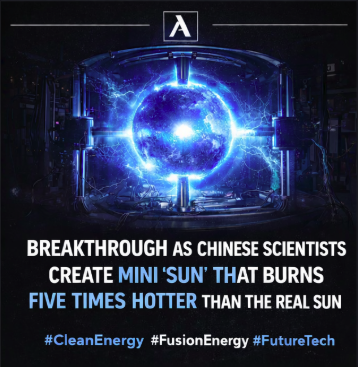
At first glance, it sounds like science fiction: Chinese scientists announcing they have created a “mini sun” on Earth, reaching temperatures several times hotter than the surface of the real Sun. Headlines spread fast, social media reacts faster, and skepticism follows immediately.
But behind the dramatic phrasing lies a very real scientific achievement: controlled nuclear fusion.
This is not a new dream. Fusion has been called the “holy grail” of energy for decades. What makes this experiment different is not just the temperature reached, but what it signals about how close humanity may be to replicating the power of stars for practical use.
What Is the “Mini Sun,” Really?
The so-called “mini sun” is not a literal star. It is a fusion reactor, designed to recreate the same physical process that powers the Sun and other stars: nuclear fusion.
In simple terms:
-
Fusion occurs when light atomic nuclei (usually hydrogen isotopes) are forced together.
-
When they fuse, they release enormous amounts of energy.
-
This is the opposite of nuclear fission, which splits heavy atoms and produces radioactive waste.
The Chinese experiment used a tokamak-style reactor, a doughnut-shaped magnetic chamber that confines ultra-hot plasma using powerful magnetic fields. Inside, temperatures reached well over 100 million degrees Celsius, far hotter than the Sun’s surface.
Why so hot? Because on Earth, unlike in the Sun, we don’t have massive gravity helping atoms fuse. Temperature and pressure must do the work instead.
Why Fusion Is So Hard
If fusion is so powerful, why don’t we already use it?
Because controlling it is incredibly difficult.
Fusion requires:
-
Extreme temperatures
-
Perfect magnetic confinement
-
Stable plasma behavior
-
Sustained reactions over long periods
For decades, experiments managed only brief bursts of fusion before losing stability. The breakthrough here is not just peak temperature, but improved control and duration, showing progress toward reactors that can actually operate reliably.
This is why scientists don’t talk about “success” or “failure,” but about incremental milestones.
Why This Changes the Energy Conversation
If fusion becomes commercially viable, the implications are enormous.
Fusion energy promises:
-
Virtually limitless fuel (hydrogen isotopes from water)
-
No carbon emissions
-
No long-lived radioactive waste
-
No risk of meltdown like traditional nuclear plants
In short: clean, scalable, baseload energy.
That’s why governments and private companies around the world are investing billions into fusion research. The Chinese “mini sun” experiment adds to a growing global momentum suggesting fusion is no longer purely theoretical.
Space Technology Without Leaving Earth
Fusion research sits at the intersection of space science and planetary survival.
Stars are nature’s fusion reactors. Understanding and replicating their mechanics gives us:
-
Better astrophysical models
-
Deeper insight into stellar evolution
-
Technologies that may one day power spacecraft or off-planet colonies
In that sense, fusion is as much a space technology as it is an energy solution. It is about learning how the universe works — and applying that knowledge here.
Why Headlines Can Be Misleading
“Mini sun” makes for a great headline. But it also creates confusion.
This experiment does not mean:
-
Fusion power is ready tomorrow
-
The energy crisis is solved
-
Coal and gas plants will disappear overnight
What it does mean is progress. Real, measurable, peer-reviewed progress.
Science moves forward not through single miracles, but through accumulated breakthroughs. This is one of them.
The Bigger Picture: Control, Not Just Power
There is another layer worth noticing.
Fusion is not just about energy. It is about control over extreme systems:
-
Plasma physics
-
Advanced materials
-
Superconducting magnets
-
Precision engineering at unprecedented scales
Mastering fusion means mastering complexity. And that capability spills over into many other technologies, from space exploration to advanced manufacturing.
So, Is This the Future?
Maybe. Not tomorrow. But sooner than many expected.
What makes this moment interesting is not hype, but convergence:
-
Better simulations
-
Stronger magnets
-
Improved materials
-
Global collaboration and competition
Fusion no longer feels like a distant promise. It feels like a long road where, finally, milestones are appearing closer together.
Final Thought
Calling it a “mini sun” is poetic, but also accurate in spirit. Humanity is learning to reproduce the fundamental engine of the universe — not to dominate it, but to survive more intelligently within it.
As always, excitement should be balanced with verification.
Verify the sources. Verify the science.
And then watch closely — because this story is far from over.